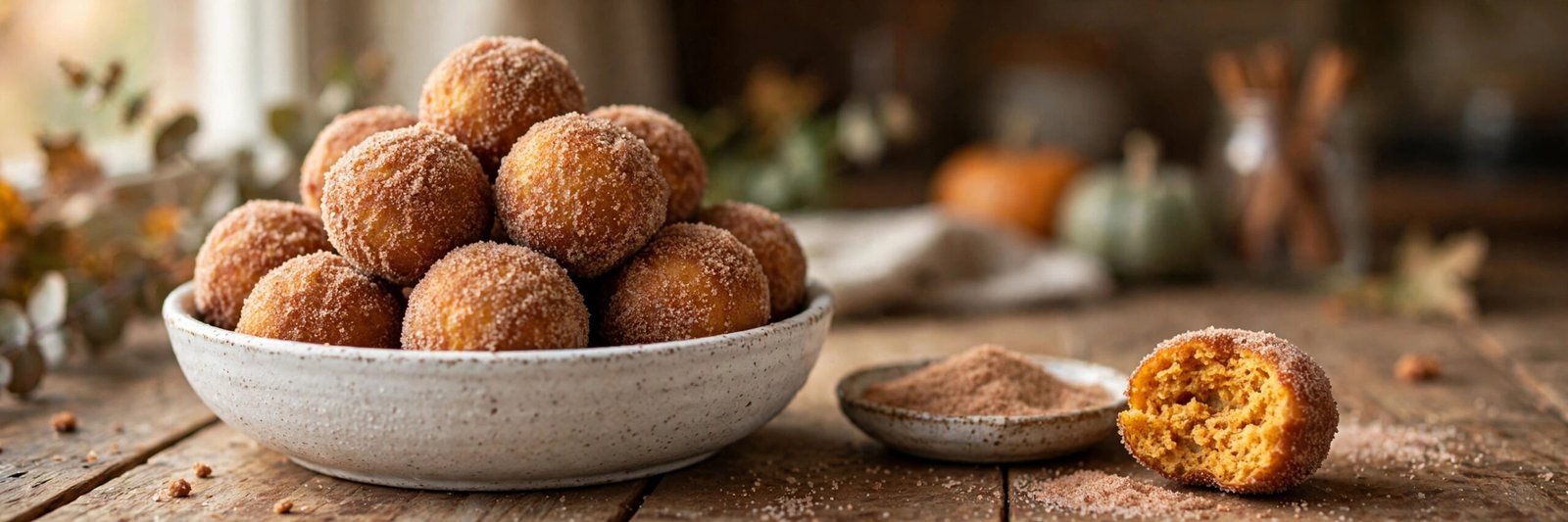
The first time I made Air Fryer Pumpkin Donut Holes, I burned the first batch. Not badly — just the bottoms, a little dark, a little bitter. I had the air fryer cranked to 400°F because I was in a hurry, and I figured hotter meant faster. It did. Faster to burn, anyway. The second batch, at 350°F, came out golden and soft and smelling like a candle shop in the best possible way. I ate four standing over the counter before they even made it to a plate.
That’s the whole story of this recipe, really. It’s fast, it’s forgiving once you know the temperature, and it’s dangerously easy to eat too many of. Twenty-four little donut holes sounds like a lot until you watch them disappear. They don’t last a day in my house. They barely last an hour.
Pumpkin and the air fryer were made for each other. The hot circulating air does something a regular oven can’t quite manage: it crisps the outside of each little ball while the inside stays soft and cake-like. No pot of oil. No splatter on the stove. No standing over a thermometer wondering if the oil is hot enough. You scoop, you roll, you drop them in the basket, and ten minutes later you’re rolling them in cinnamon sugar.
The flavor is straight-up fall. Real pumpkin purée, not the spiced pie filling from the can with the label that looks almost the same — that’s a mistake worth avoiding, and I’ll explain it below. Cinnamon, nutmeg, ginger, a little allspice. The coating is warm butter and cinnamon sugar, which sticks to the donut holes while they’re still hot and turns into a crackly-sweet shell as they cool.
They’re the kind of thing you make on a Saturday morning when the weather turns. Coffee’s brewing, the kitchen smells like a bakery, and there’s a bowl of warm donut holes on the counter. Nobody asks what’s for breakfast. They just reach for one.
⚡ Quick Answer: Whisk 1½ cups flour, 1 teaspoon baking powder, ½ teaspoon baking soda, 1½ teaspoons pumpkin pie spice, ½ teaspoon cinnamon, and ¼ teaspoon salt. In another bowl, stir together ⅔ cup pumpkin purée, ⅓ cup brown sugar, ¼ cup granulated sugar, 1 egg, 3 tablespoons melted butter, and 1 teaspoon vanilla. Fold the dry into the wet until just combined. Roll the sticky dough into 24 balls, about 1½ inches across. Mist the air fryer basket with oil spray, set the balls in a single layer with space between them, and air fry at 350°F (177°C) for 8–10 minutes, flipping once, until golden and springy. While they’re still hot, brush with 3 tablespoons melted butter and roll in ½ cup sugar mixed with 1 tablespoon cinnamon. Eat warm.
TL;DR – Recipe at a Glance
- Prep time: 15 minutes — mix, roll, done
- Cook time: 8–10 minutes per batch, 2–3 batches
- Total time: About 35 minutes from first stir to first bite
- Yield: 24 donut holes
- Calories: About 90 per donut hole
- Difficulty: Easy — if you can roll a ball of dough, you can make these
- Best for: Fall breakfasts, Halloween parties, Thanksgiving dessert tables, and after-school snacks
- Equipment: Air fryer, 2 mixing bowls, measuring cups and spoons, cookie scoop or tablespoon, small bowl for the cinnamon sugar
Why You’ll Love These Air Fryer Pumpkin Donut Holes
- No deep frying, no oil splatter. The air fryer does the crisping. Your stovetop stays clean, and there’s no pot of hot oil to deal with afterward.
- Ready in about 35 minutes. No yeast, no rising, no waiting around. The dough comes together in one bowl and goes straight into the basket.
- Soft inside, crackly outside. The air fryer gives you a golden crust that a regular oven can’t quite match, while the middle stays tender and cake-like.
- They use real pumpkin. Not a mix, not a syrup, not a flavored coffee creamer. Actual pumpkin purée, which keeps them moist for days.
- One batch feeds a crowd. Twenty-four donut holes sounds like plenty. It isn’t, but it sounds like it. Double the batch and you’ve got a party dessert.
- Kids can help roll them. The dough is sticky, the rolling is messy, and children love both of those things. Give them a bowl of cinnamon sugar and stand back.
- They reheat beautifully. Two minutes back in the air fryer and a day-old donut hole tastes almost fresh. The microwave can’t do that.
The Recipe Card
Time and Yield
| Prep time | 15 minutes |
| Cook time | 8–10 minutes per batch |
| Total time | About 35 minutes |
| Yield | 24 donut holes |
| Serving size | 2 donut holes |
| Calories | About 90 per donut hole |
Recipe Overview
| Course | Dessert / Breakfast |
| Cuisine | American |
| Method | Air fryer |
| Air fryer temperature | 350°F (177°C) |
| Pan | Air fryer basket, lightly oiled |
| Make-ahead | Yes — dough keeps 24 hours in the fridge |
| Freezer-friendly | Yes — uncoated, up to 2 months |
| Dietary notes | Vegetarian; contains gluten, dairy, and eggs |
Ingredients
For the donut hole dough:
- 1½ cups all-purpose flour (190 g) — spooned and leveled, not scooped from the bag
- 1 teaspoon baking powder — the main lift
- ½ teaspoon baking soda — helps with browning and tenderness
- 1½ teaspoons pumpkin pie spice — cinnamon, nutmeg, ginger, and allspice in one jar
- ½ teaspoon ground cinnamon — on top of the spice blend, because pumpkin loves cinnamon
- ¼ teaspoon fine salt — keeps the sweetness in check
- ⅔ cup pumpkin purée — canned 100% pumpkin, not pumpkin pie filling
- ⅓ cup packed light brown sugar — adds moisture and a caramel note
- ¼ cup granulated sugar
- 1 large egg, room temperature
- 3 tablespoons unsalted butter, melted and slightly cooled
- 1 teaspoon vanilla extract — pure if you have it
- 2 tablespoons milk — only if the dough feels too stiff
For the cinnamon sugar coating:
- ½ cup granulated sugar
- 1 tablespoon ground cinnamon
- 3 tablespoons unsalted butter, melted — for brushing, so the sugar sticks
Equipment
- Air fryer (basket or oven style)
- 2 mixing bowls (one medium, one large)
- Whisk and rubber spatula
- Measuring cups and spoons
- Cookie scoop (1½-tablespoon size) or a tablespoon
- Small shallow bowl for the cinnamon sugar
- Pastry brush
- Oil spray or a little neutral oil for the basket
Quick Instructions
- Whisk the flour, baking powder, baking soda, pumpkin pie spice, cinnamon, and salt in a medium bowl.
- In a large bowl, stir the pumpkin purée, both sugars, egg, melted butter, and vanilla until smooth.
- Fold the dry ingredients into the wet with a spatula until just combined. The dough will be soft and sticky — that’s right.
- Lightly oil your hands, then roll the dough into 24 balls, about 1½ inches across.
- Mist the air fryer basket with oil spray. Set the balls in a single layer with at least an inch between them.
- Air fry at 350°F (177°C) for 8–10 minutes, flipping halfway, until golden brown and springy to the touch.
- Brush each hot donut hole with melted butter, then roll in the cinnamon sugar until coated.
- Serve warm. They peak about 10 minutes after coating, when the sugar has set and the inside is still warm.
The Pumpkin Purée Mistake That Ruins Everything
Two cans sit next to each other on the baking aisle, and they look almost identical. Same size. Same orange color. Same brand. One says “100% Pumpkin.” The other says “Pumpkin Pie Mix” or “Pumpkin Pie Filling.” Grab the wrong one and the recipe falls apart — not dramatically, but enough that you’ll wonder why the donut holes taste off.
Pumpkin pie filling is pumpkin purée with sugar and spices already mixed in. It sounds convenient. It isn’t, here. It throws off the sugar balance in the dough, adds spices you can’t control, and usually makes the batter too wet. The donut holes come out gummy in the middle and too sweet on the outside. The can of plain purée is the one you want. Just pumpkin, cooked and mashed, nothing else.
Canned pumpkin is also, honestly, better than fresh for this recipe. I know that sounds wrong. Fresh sounds better. But canned pumpkin is made from specific varieties — Dickinson pumpkins, mostly — that are bred for smooth texture and low water content. The pumpkin you carve at Halloween is a different variety entirely. It’s stringy, watery, and bland. People roast it, purée it, and then wonder why their baked goods taste like wet squash. If you do use fresh pumpkin, roast it, drain it in a fine-mesh strainer for at least 30 minutes, and expect a softer dough that needs a spoonful or two of extra flour.
Check the can before you open it. Shake it. If it sloshes, it’s too watery — some cheaper brands are. You want a thick purée that holds its shape on a spoon. Libby’s is the standard most recipes are tested with, and it earns that spot. Store brands vary. If your purée looks thin, blot it: spread it on a plate lined with paper towels, press another towel on top, and let it sit for five minutes. You’ll pull out a surprising amount of water, and your donut holes will thank you.
One can is 15 ounces, about 1¾ cups. This recipe uses ⅔ cup. That leaves a full cup sitting in the fridge, and it keeps for about a week. Use it. Make a second batch. Or stir it into oatmeal, or bake a batch of our pumpkin protein muffins with greek yogurt — same can, same week, no waste.
Donut Holes Have a Real History, and It’s Shorter Than You’d Think
The donut hole is a 19th-century American invention, and it started as trash. Literally. When bakers fried ring-shaped donuts, the centers came out raw while the outside burned — the middle of a solid ball of dough takes forever to cook through. The fix was to cut the center out entirely. The ring cooked evenly. The little cut-out circles got fried too, because why waste dough, and somebody realized the scraps were the best part.
Hanson Gregory, a Maine sea captain, claimed in 1847 that he invented the ring donut by poking a hole in the center with a tin pepper box on his ship, because the middle was always soggy. Food historians argue about whether that’s true — the Dutch were frying oily cakes called olykoeks long before that — but the point stands. The hole solved a cooking problem. The hole’s leftovers became a snack of their own.
Cider mills in New England turned donut holes into a fall tradition. You’d buy a bag of them warm, dusted in cinnamon sugar, with a cup of hot apple cider. That combination — pumpkin spice, cinnamon sugar, a warm fried ball of dough — is exactly what this recipe is chasing. The air fryer just gets you there without the vat of oil.
The name is a little funny, too. A donut hole has no hole. It’s the part that used to be the hole. The name stuck anyway, the way food names do, and now nobody questions it.
Why the Air Fryer Wins Here
Three ways to cook a donut hole: deep fry, bake, or air fry. They all work. They don’t all work equally well.
Deep frying gives you the crispiest crust and the most classic donut texture. It also gives you a pot of oil to heat, monitor, and dispose of. It gives you splatter on the stove and a kitchen that smells like a fryer for a day. For a weekend project, fine. For a Tuesday morning, no.
Baking is the cleanest method. Scoop, roll, bake at 350°F for 12–14 minutes. The results are good — soft, cake-like, a little pale. The outside never quite crisps. Baked donut holes taste like muffins shaped into balls, which is not an insult, but it’s not a donut either.
The air fryer splits the difference and then some. The fan pushes hot air around each ball from every side. The outside sets fast, which keeps the inside moist. You get a golden, slightly crisp shell that holds cinnamon sugar like it was designed for it. And the whole thing takes 8–10 minutes a batch, with no oil to heat up or throw away.
| Method | Time | Crust | Cleanup | Best for |
|---|---|---|---|---|
| Air fryer | 8–10 min per batch | Golden, lightly crisp | Basket rinse | Weekday baking, small batches |
| Deep fried | 2–3 min per batch | Deepest brown, crispiest | Oil disposal, splatter | Classic texture, big batches |
| Oven baked | 12–14 min | Soft, pale | One baking sheet | No air fryer, hands-off cooking |
One thing the air fryer demands: space. The balls need room. Crowd them and the hot air can’t circulate, and you get pale, soft donut holes that steam instead of crisp. Eight to ten per batch in a standard basket. It feels slow when you’re staring at 24 balls of dough and a basket that holds nine. It isn’t slow. Each batch is under ten minutes. Use the time to mix the cinnamon sugar and melt the butter.
The Dough: Sticky Is Correct
First-timers always worry about this dough. It’s soft. It’s sticky. It clings to your fingers and the bowl and everything it touches. That means you did it right.
Pumpkin purée is about 90% water. That moisture is what keeps the donut holes soft for days — and it’s also what makes the dough impossible to roll neatly with dry hands. The fix is simple: wet your hands, or oil them lightly. A little water on your palms stops the sticking without adding flour to the dough, and adding flour is the real danger. Every extra spoonful of flour makes the donut holes denser. The dough is supposed to be soft. Trust it.
Mix it gently. Stir the wet ingredients until smooth, then fold the dry in with a spatula and stop as soon as the last streak of flour disappears. Ten extra strokes won’t ruin them, but thirty will. Overmixed dough develops gluten, and gluten makes donut holes tough and chewy instead of tender. You want a soft, cake-like crumb. That comes from a light hand.
The dough should hold a ball shape when you roll it, even if it slumps a little. If it spreads flat in your palm like pancake batter, your pumpkin purée was too wet — add flour one tablespoon at a time until it holds. If it cracks and feels dry, your flour measurement was heavy — add milk a teaspoon at a time. Flour measured by scooping straight from the bag can be 20% heavier than flour spooned and leveled. That one habit — spoon, level, pour — matters more in this recipe than in almost any other on this site, because there’s so little flour holding everything together.
Size matters too. Aim for balls about 1½ inches across, roughly the size of a golf ball. A cookie scoop keeps them even. Even matters because the air fryer cooks by time, and a big ball next to a small one means one is raw and the other is dry. If you don’t have a scoop, a tablespoon works — one heaping tablespoon per ball, rolled between oiled palms.
Step-by-Step: Making Air Fryer Pumpkin Donut Holes
Step 1: Mix the Dry Ingredients
Put the flour, baking powder, baking soda, pumpkin pie spice, cinnamon, and salt in a medium bowl. Whisk them together for a good 30 seconds. This isn’t a throwaway step. Baking powder and baking soda need to be spread evenly through the flour, or you’ll get donut holes that rise lopsided — one side puffed, the other flat. The whisk does that work. So does the spice: a clump of cinnamon in one ball and none in the next makes for an uneven batch.
Step 2: Stir the Wet Ingredients
In a large bowl, stir the pumpkin purée, brown sugar, granulated sugar, egg, melted butter, and vanilla. Use a whisk or a fork. Keep going until the mixture looks smooth and uniform, about a minute. The brown sugar takes a moment to dissolve into the wet purée — you’ll feel the grit disappear as you stir. Don’t rush it. Undissolved sugar leaves crunchy pockets in the finished donut holes.
The butter should be melted but not hot. If it’s still steaming, let it sit for two minutes. Hot butter cooks the egg on contact, and you’ll get tiny bits of scrambled egg in the dough. Not the end of the world, but not what anyone wants to bite into.
Step 3: Bring the Dough Together
Pour the dry ingredients into the wet bowl. Fold with a rubber spatula — scoop from the bottom, lift, turn. Stop the moment the last streak of flour disappears. The dough will look rough and feel soft and sticky. That’s exactly right.
If the dough looks more like batter than dough, don’t panic. It firms up as it sits for a minute or two — the flour absorbs the moisture from the pumpkin. Give it three minutes on the counter before you decide it needs more flour. Most of the time, it doesn’t.
Step 4: Roll the Balls
Lightly oil your hands with a little neutral oil, or wet them under the tap. Scoop about a heaping tablespoon of dough and roll it between your palms into a ball about 1½ inches across. Set it on a plate. Repeat. You’ll get about 24.
They don’t have to be perfect spheres. Slightly lumpy is fine. The air fryer rounds them out as they bake and puff. What matters is size — keep them close to the same, so they finish at the same time. If one is twice the size of the others, it stays doughy in the middle while the small ones dry out.
Step 5: Load the Basket
Mist the air fryer basket with oil spray, or brush it lightly with oil. Don’t skip this. Pumpkin dough sticks, and a stuck donut hole tears when you flip it.
Set the balls in a single layer with at least an inch between them. Eight or nine in a standard basket. Resist the urge to squeeze in one more. That one extra ball blocks the airflow for all of them. The rest go on a plate and wait their turn — two minutes of patience, and they cook better for it.
Step 6: Air Fry at 350°F
Slide the basket in. Set the temperature to 350°F (177°C) and the timer for 8 minutes. At the halfway mark — about 4 minutes — open the basket and flip each ball with tongs or a fork. They should already look golden on the bottom.
Total time is usually 8–10 minutes. They’re done when they’re deep golden brown all over and spring back when you poke one gently. If you’re not sure, pull one out and cut it open. The inside should be fully set, soft, and orange — no wet, shiny streak of raw dough in the center. If there is, give them two more minutes.
Step 7: Butter and Sugar, While They’re Hot
This step has a clock on it. The donut holes need to be hot when they hit the cinnamon sugar, or the sugar won’t stick. Melt the 3 tablespoons of butter in a small bowl. Mix the sugar and cinnamon in a shallow bowl.
Work in small groups — four or five at a time. Brush a donut hole with melted butter, drop it in the cinnamon sugar, and roll it until it’s coated all over. Set it on a plate. Repeat. The butter is the glue. Without it, the sugar slides right off and pools at the bottom of the bowl. With it, the sugar clings and sets into a sweet, crackly coat as the donut holes cool.
Don’t dump all 24 into the sugar bowl at once. They pile up, the sugar clumps, and the ones at the bottom get crushed. Four or five at a time. It takes three minutes. Worth it.
Step 8: Let Them Set for 10 Minutes
They’re edible right away, and honestly, one straight from the sugar bowl is hard to resist. But they taste better after ten minutes. The sugar coating firms up. The inside settles. The heat evens out. Ten minutes is the difference between a good donut hole and a great one.
Serve them warm, on a plate or in a bowl, with coffee. That’s the whole serving plan. They don’t need a garnish. They don’t need a drizzle. They are the garnish.
The Cinnamon Sugar Coat: Small Details, Big Difference
The coating looks simple — sugar plus cinnamon — and it is. But the ratio and the timing decide whether it tastes like a donut shop or like sweet dust.
Half a cup of sugar to one tablespoon of cinnamon. That’s the ratio. More cinnamon and the coating turns bitter and dark. Less and it tastes like plain sugar. One tablespoon is the line. Use a fresh jar of cinnamon if yours has been open for a year. Ground cinnamon loses its punch after about six months, and stale cinnamon tastes like sawdust with ambitions.
Brush, don’t dip, the butter. Dunking a donut hole in melted butter soaks the crust and makes it soggy. A light brush — just enough to make the surface tacky — holds the sugar without drowning the crust. A pastry brush is the right tool. A spoon works in a pinch, but you’ll use too much.
Roll them while they’re hot, but not scorching. Straight out of the basket is too hot — the sugar melts into a glaze instead of a coating. Wait 60 seconds. The surface is still warm enough to grab the sugar, and the coating stays crunchy. If you wait five minutes, the surface cools and the sugar won’t stick at all. That 60-second window is the whole trick.
One more thing: save the leftover cinnamon sugar. It keeps for months in a jar, and it’s the best toast topping you’ve ever had. Sprinkle it on buttered toast, on oatmeal, on the rim of a coffee mug. Don’t throw it away.
Troubleshooting: When Things Go Wrong
Almost everything that goes wrong with this recipe comes down to three things: temperature, moisture, or crowding. The fixes are short.
| Problem | Likely cause | Fix |
|---|---|---|
| Raw, wet center | Balls too big, or temperature too high so the outside set before the inside cooked | Roll smaller (1½ inches), drop to 340°F, add 2 minutes |
| Dry and crumbly | Too much flour, or baked too long | Spoon and level the flour; check at 8 minutes, not 10 |
| Pale and soft, no crust | Basket too crowded, or temperature too low | Cook 8–9 per batch with space; check your air fryer runs true to 350°F |
| Sugar won’t stick | Donut holes cooled too much before coating | Coat within 1–2 minutes of the basket; re-brush with butter if they cooled |
| Sugar melts into a glaze | Coated while scorching hot | Wait 60 seconds after the basket before coating |
| Sticking to the basket | Basket not oiled, or balls placed on a dry basket | Mist or brush with oil every batch, not just the first |
| Flat, spread-out balls | Dough too wet from thin pumpkin purée | Blot the purée with paper towels; add flour 1 tablespoon at a time |
| Bitter or dark coating | Too much cinnamon, or cinnamon burned in the basket | Keep the ratio at ½ cup sugar to 1 tablespoon cinnamon; coat after cooking, never before |
| Uneven browning | Didn’t flip halfway | Flip at 4 minutes; every air fryer has a hot spot |
| Tough and chewy | Dough overmixed | Fold until just combined; stop at the last streak of flour |
The raw-center problem deserves one more word. It’s the most common complaint with air fryer baking, and it almost always means the temperature was too high. At 400°F, the outside of a dough ball sets in two minutes and forms a shell. The heat can’t get through the shell fast enough, so the middle stays raw while the outside darkens. At 350°F, the heat moves through the whole ball at a steadier pace. Slower is faster here. Ten minutes at the right temperature beats eight minutes at the wrong one.
Toppings and Glazes Worth Trying
Cinnamon sugar is the classic, and it’s the one in the recipe card. But these donut holes take to other finishes just as well. Here are the ones that actually work, not the ones that sound good in theory.
- Maple glaze. Whisk 1 cup powdered sugar with 2 tablespoons maple syrup and 1 tablespoon milk. Dip the tops of warm donut holes in the glaze and let it set for 10 minutes. It tastes like a pancake house in October.
- Powdered sugar snow. Skip the butter and cinnamon sugar. Let the donut holes cool completely, then dust them heavily with powdered sugar through a fine sieve. They look like little snowballs. The sugar melts into the crust after an hour, so dust them right before serving.
- Chocolate drizzle. Melt ½ cup chocolate chips with 1 teaspoon coconut oil. Drizzle over the cooled, cinnamon-sugared donut holes with a fork. The chocolate sets in about 15 minutes. Kids pick these first.
- Cream cheese glaze. Beat 2 ounces softened cream cheese with ½ cup powdered sugar, 1 tablespoon milk, and ½ teaspoon vanilla. Dip or drizzle. It tastes like the frosting on a cinnamon roll and pairs with the pumpkin in a way that makes people go quiet for a second.
- Brown butter coating. Brown the 3 tablespoons of butter in a pan until it smells nutty and the milk solids turn amber, then brush it on before the cinnamon sugar. It’s a small change — five extra minutes — and it adds a toasty depth that plain melted butter doesn’t have.
- Spiced sugar swap. Replace the cinnamon in the coating with pumpkin pie spice. Same ratio, different warmth. The nutmeg and ginger come forward, and the whole thing tastes more like pie.
- Salted caramel drizzle. Warm a jar of caramel sauce, drizzle it over the finished donut holes, and sprinkle a pinch of flaky sea salt on top. Rich, sticky, and the one to make when you want to impress someone.
One finish to skip: a full dunk in glaze while the donut holes are still hot. The glaze slides off and pools on the plate. Glazes go on warm donut holes, never hot ones. Let them cool for five minutes first.
Variations Worth Trying
The base recipe is solid, and it bends without breaking. These are the changes I’ve made and would make again.
- Gluten-free. Swap the all-purpose flour for a 1-to-1 gluten-free baking blend, the kind with xanthan gum already in it. The dough will be a little softer — chill it for 15 minutes before rolling. They come out nearly identical, maybe a touch more tender.
- Dairy-free. Use melted coconut oil or a neutral vegetable oil in place of the butter, and oat milk or almond milk instead of the milk. For the coating, brush with melted coconut oil. The flavor shifts slightly toward coconut, and nobody complains.
- Baked in the oven. No air fryer? Roll the balls, set them on a parchment-lined baking sheet, and bake at 350°F for 12–14 minutes. Brush with butter and roll in cinnamon sugar the same way. The crust is softer and paler, but the flavor is all there.
- Mini donut hole bites. Roll the dough into 1-inch balls instead of 1½-inch ones. You’ll get about 36. Air fry for 6–7 minutes. They’re pop-in-your-mouth size, and they vanish even faster than the regular ones.
- Stuffed with cream cheese. Flatten a ball of dough in your palm, put a teaspoon of sweetened cream cheese in the center, and fold the dough around it. Seal it well. Air fry as usual, adding one minute. The middle stays molten for about ten minutes after cooking.
- Apple cider twist. Replace the 2 tablespoons of milk with 2 tablespoons of reduced apple cider — simmer a cup of cider down to a quarter cup. The flavor leans toward our mini apple cider cheesecakes, but in bite-size form.
- Chocolate chip. Fold ⅓ cup mini chocolate chips into the dough at the very end. They melt into little pockets as the donut holes bake. Use mini chips, not regular — the regular ones are too big for a 1½-inch ball and poke through the surface.
What to Serve With Them
Coffee first. Always coffee first. A dark roast, black or with a splash of cream, cuts through the sweetness and the spice in a way that makes both taste better. A pumpkin spice latte next to pumpkin donut holes is too much of the same thing — like wearing two of the same sweater. Plain coffee is the move.
Hot apple cider is the second-best partner, and the most seasonal one. The tartness of the cider balances the sugar coating, and the whole combination tastes like a fall festival. Mulled cider, with a cinnamon stick in the mug, is even better.
On a brunch table, they sit next to savory food. Eggs, bacon, sausage — the salt and fat reset your palate between donut holes, which is the only way anyone stops at a reasonable number. On a dessert table, they go next to lighter things: fresh fruit, a bowl of whipped cream, something tart. Our mini apple cider cheesecakes make a good table-mate — same season, different texture. If the table needs one more fall bake, our small batch pumpkin cinnamon rolls bring the same spice family in a softer, pull-apart form.
For a Halloween party, pile them in a bowl and put out toothpicks. People eat them like popcorn. For Thanksgiving, make them the morning of, while the turkey rests. They fill the gap between dinner and dessert, and they keep the kitchen smelling like the holidays.
Storage, Freezing, and Making Ahead
These are best warm, within a few hours of cooking. They don’t fall apart after that, though. They hold up better than most fried dough, because the pumpkin keeps the crumb moist.
| Situation | How long | How to store |
|---|---|---|
| At room temperature, coated | 1 day | Airtight container, single layer |
| In the fridge, coated | 3–4 days | Airtight container; the sugar softens a little |
| In the freezer, uncoated | Up to 2 months | Freeze on a tray, then bag; coat after reheating |
| In the freezer, coated | Not recommended | The sugar turns sticky and weepy when thawed |
| Dough, unbaked | 24 hours in the fridge | Covered bowl; roll and cook straight from the fridge, add 1 minute |
| Reheating | 2–3 minutes | Air fryer at 300°F (150°C); the coating crisps back up |
The reheating trick is the one that saves a batch. A day-old donut hole, microwaved, turns soft and sad. The same donut hole, two minutes in the air fryer at 300°F, comes back with a crisp coating and a warm center. It isn’t quite as good as fresh. It’s close enough that nobody will know.
Freezing works best uncoated. Cook the donut holes, let them cool completely, freeze them in a single layer on a tray, then move them to a freezer bag. To serve, reheat from frozen at 320°F for 5–6 minutes, brush with butter, roll in cinnamon sugar, and serve. They taste like you made them that morning.
Scaling the Recipe Up or Down
The recipe makes 24, which is one standard batch and about three rounds in the air fryer. That’s the natural size, and I’d keep it there unless you have a reason to change it.
A half batch works fine — 12 donut holes, same temperature, same time. The dough halves cleanly. Just use half an egg: beat it, measure out about 1½ tablespoons, and save the rest for scrambled eggs. A double batch needs two rounds of mixing, because the dough gets hard to fold evenly in one giant bowl. Mix it in two separate batches, same as always.
If you’re cooking for a party, the honest answer is to make them in waves. Cook a batch, coat it, put it out. Cook the next batch while people eat the first. Warm donut holes coming out of the kitchen in rounds is better than a cold pile of 48 sitting on the counter. The air fryer is fast enough that nobody waits long.
Nutrition: What’s Actually in One Donut Hole
A donut hole is a treat. It’s fried dough rolled in sugar, and no amount of pumpkin changes that. But the numbers are kinder than a bakery donut, mostly because the air fryer skips the oil bath and the portion is small.
One donut hole, as written, is about 90 calories. Two of them — a normal serving — is about 180 calories, roughly the same as a small muffin. The pumpkin adds fiber and vitamin A, which a plain donut doesn’t have. A cup of canned pumpkin has about 7 grams of fiber and more than 700% of the daily value of vitamin A. You only get a fraction of that per donut hole, but it’s real nutrition in a dessert, which is more than most donuts can say.
| Nutrient | Amount per donut hole |
|---|---|
| Calories | About 90 |
| Total fat | 3 g |
| Saturated fat | 1.5 g |
| Carbohydrates | 15 g |
| Sugar | 8 g |
| Protein | 1.5 g |
| Fiber | 1 g |
| Sodium | 55 mg |
| Vitamin A | About 15% daily value |
These are estimates, not lab results. Your numbers will shift a little depending on how thick your coating is and how much butter you brush on. A heavy hand with the butter adds about 10 calories per hole. A light hand takes them away. Nobody’s counting that closely at a party, and they shouldn’t be.
Air Fryer vs. Bakery Donut Holes: An Honest Comparison
Bakery donut holes are usually deep-fried yeast dough. They’re lighter, airier, and they go stale faster. These are cake-style, which means denser, more tender, and longer-lasting. Neither is better. They’re different desserts that happen to share a shape.
| Air fryer pumpkin donut holes | Bakery yeast donut holes | |
|---|---|---|
| Dough type | Cake-style, baking powder | Yeast-raised |
| Cooking | Hot air, no oil bath | Deep fried |
| Time from start | About 35 minutes | 2+ hours with rising |
| Texture | Tender, cake-like, moist | Light, airy, chewy |
| Stays fresh | 1 day at room temp, 3–4 in the fridge | A few hours, then stale |
| Flavor | Pumpkin spice, cinnamon sugar | Usually plain or glazed |
| Cleanup | Basket rinse | Oil disposal |
| Best for | Fall baking, small batches | Classic donut shop taste |
If you want the bakery version, buy it from a bakery. If you want a warm, spiced donut hole in half an hour without leaving the house, this is your recipe.
Frequently Asked Questions
Can I use fresh pumpkin instead of canned?
Yes, but it takes work. Roast a sugar pumpkin — the small ones, not the carving kind — until soft, scoop out the flesh, and purée it. Then drain it in a fine-mesh strainer for at least 30 minutes, pressing out the water. Fresh pumpkin holds far more water than canned, and if you skip the draining, the dough turns to batter. Canned purée is smoother, drier, and more consistent. For this recipe, canned wins.
Do I need to preheat the air fryer?
It helps, but it isn’t a dealbreaker. A 3-minute preheat at 350°F gives you a hotter basket, which sets the outside of the donut holes faster and gives you a better crust. If you skip it, add about a minute to the cook time. The first batch in a cold basket always takes a little longer than the second batch in a hot one. Either way, flip at the halfway mark.
Why did my donut holes come out dense?
Two usual reasons. The first is too much flour — scooping from the bag instead of spooning and leveling can add 20% more flour, and that alone makes them dense. The second is overmixing. Once the flour goes in, fold gently and stop at the last streak. Extra stirring builds gluten, and gluten makes cake-style dough tough. Measure carefully, mix lightly, and they’ll stay tender.
Can I make the dough ahead of time?
Yes. Mix the dough, cover the bowl, and refrigerate it for up to 24 hours. The cold dough is actually easier to roll — it firms up and sticks to your hands less. Roll it straight from the fridge and add about a minute to the cook time, since the balls start cold. Don’t leave the dough out at room temperature for more than an hour before cooking.
Can I bake these in the oven instead?
Yes. Roll the balls, set them on a parchment-lined baking sheet with space between them, and bake at 350°F (177°C) for 12–14 minutes, until golden and springy. Brush with butter and roll in cinnamon sugar the same way. The crust comes out softer and paler than the air fryer version, but the flavor is all there. It’s a good fallback when the air fryer is busy or broken.
How do I keep the cinnamon sugar from falling off?
Coat them while they’re hot — within a minute or two of leaving the basket — and brush them with melted butter first. The butter is the glue. If the donut holes have already cooled, the sugar won’t stick no matter how much you roll them. Brush them again with a little warm butter and try once more. The 60-second wait after the basket matters: scorching hot melts the sugar, cold won’t hold it, warm is just right.
Can I freeze pumpkin donut holes?
Yes — freeze them uncoated. Let them cool completely, freeze in a single layer on a tray, then bag them for up to 2 months. Reheat from frozen at 320°F for 5–6 minutes in the air fryer, then brush with butter and roll in cinnamon sugar. Don’t freeze them already coated. The sugar absorbs moisture in the freezer and turns sticky when it thaws.
What if I don’t have pumpkin pie spice?
Make your own. Stir together 1 teaspoon cinnamon, ¼ teaspoon nutmeg, ¼ teaspoon ginger, and a pinch of allspice. That’s one batch of the 1½ teaspoons this recipe needs — scale it up to 1½ teaspoons cinnamon, ⅓ teaspoon nutmeg, ⅓ teaspoon ginger, and a pinch of allspice. A jar of the blend is easier, and it lasts through the whole fall baking season, but the homemade mix tastes fresher.
Are these the same as pumpkin donut holes from a coffee shop?
Not quite, and that’s fine. Coffee shop versions are usually deep-fried yeast dough with a pumpkin glaze. These are cake-style, baked in hot air, with a cinnamon sugar coat. They’re denser, more tender, and they taste more like actual pumpkin. Think of them as cousins, not twins. If you’ve only had the coffee shop kind, these will surprise you — in a good way.
Can I use a different squash?
Yes. Butternut squash purée works almost identically — same texture, same moisture, a slightly sweeter and less earthy flavor. Sweet potato purée works too, and it pairs beautifully with the cinnamon sugar; our air fryer sweet potato cubes with cinnamon use the same spice family for a reason. Whatever you use, it needs to be a thick, smooth purée. Thin or watery squash makes a sticky dough that won’t hold a ball.
Conclusion
Air fryer pumpkin donut holes are the kind of recipe that earns a permanent spot in the fall rotation. Not because they’re fancy — they aren’t. Because they’re fast, they use one can of pumpkin you probably already have, and they make the kitchen smell like the best part of October.
The whole project takes about 35 minutes. No yeast. No rising. No pot of oil. You mix a bowl of dough, roll it into balls, and let the air fryer do the work. Ten minutes later you’re rolling warm donut holes in cinnamon sugar, and the hardest part is waiting ten minutes for them to set before eating one.
Make them on a Saturday morning. Make them for a Halloween party, piled in a bowl with toothpicks. Make them the morning of Thanksgiving, while the turkey rests and the house fills up. Double the batch if there’s a crowd. There will be a crowd, once people smell them.
And if the first batch burns a little on the bottom, like mine did — turn the temperature down to 350°F, and try again. The second batch is always the one that disappears first.