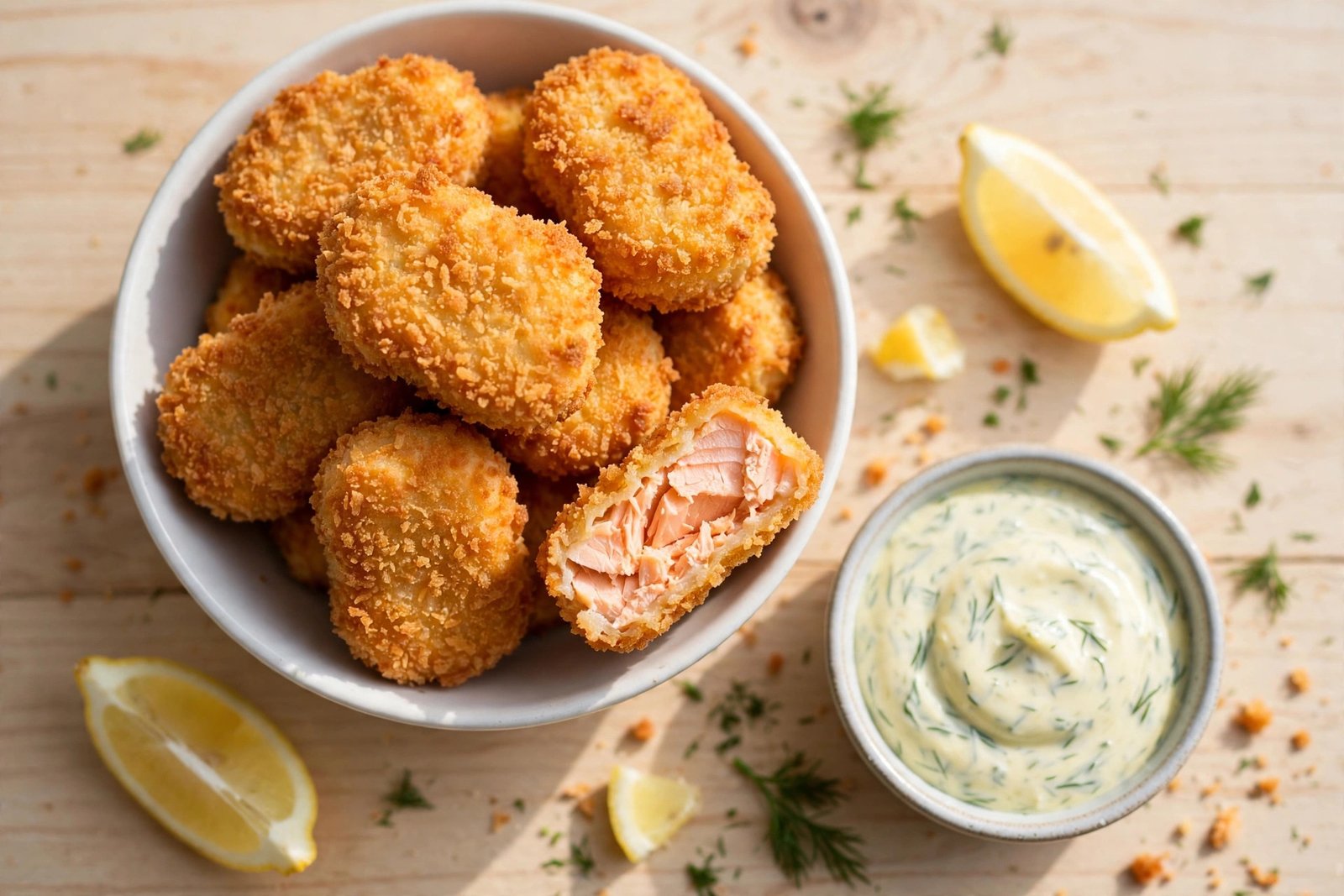
There is a particular kind of silence that falls over a dinner table when the food is genuinely good. No one is negotiating. No one is picking at the plate and asking what is in it. Everyone is just eating, reaching for one more piece, and then one more after that. Crispy air fryer salmon nuggets have that effect, and they have it on people who claim they do not even like fish.
The idea is simple enough to explain in one sentence: cubes of fresh salmon, coated in seasoned panko breadcrumbs, air-fried at high heat until the outside turns golden and shatteringly crisp while the inside stays tender and juicy. It takes about twenty minutes from start to finish, it uses a fraction of the oil that deep frying would, and it turns a fillet of salmon into something that eats like a snack and satisfies like a proper dinner.
What makes these nuggets special is the way the air fryer solves the two problems that usually make home-cooked salmon tricky. It cooks fast and evenly, so the fish never dries out, and the hot circulating air crisps the coating from every side at once — a golden crust without a pool of oil and without the soggy bottom pan-frying so often leaves behind.
This recipe is built for real weeknights. The coating takes five minutes, the nuggets cook in eight to ten, and the sauce comes together while they are in the basket. Serve them with rice and vegetables, pile them into wraps, or set them out with toothpicks and sauces at a party. It is the kind of recipe you make once, then make again the following week.
⚡ Quick Answer: Cut 600 g of skinless salmon fillet into 2.5 cm cubes, season with salt, pepper, garlic powder and paprika, then coat each cube in flour, beaten egg, and seasoned panko breadcrumbs. Lightly spray with oil, air fry in a single layer at 200°C (400°F) for 8–10 minutes, flipping halfway, until the coating is deep golden and the salmon reaches 63°C (145°F) inside. Rest for 2 minutes and serve hot with lemon wedges and your favourite dipping sauce. The whole recipe takes about 20 minutes and each serving has roughly 24 g of protein.
TL;DR – Recipe at a Glance
- Prep time: 10 minutes
- Cook time: 8–10 minutes
- Total time: About 20 minutes
- Servings: 4 servings (about 6 nuggets each)
- Cooking method: Air fryer at 200°C (400°F)
- Difficulty: Easy
- Flavour: Savoury, buttery salmon with a garlicky, lightly spiced golden crunch
- Texture: Shatteringly crisp panko outside, tender and flaky salmon inside
- Protein: About 24 g per serving
- Calories: About 320–360 per serving (nuggets only, before dipping sauce)
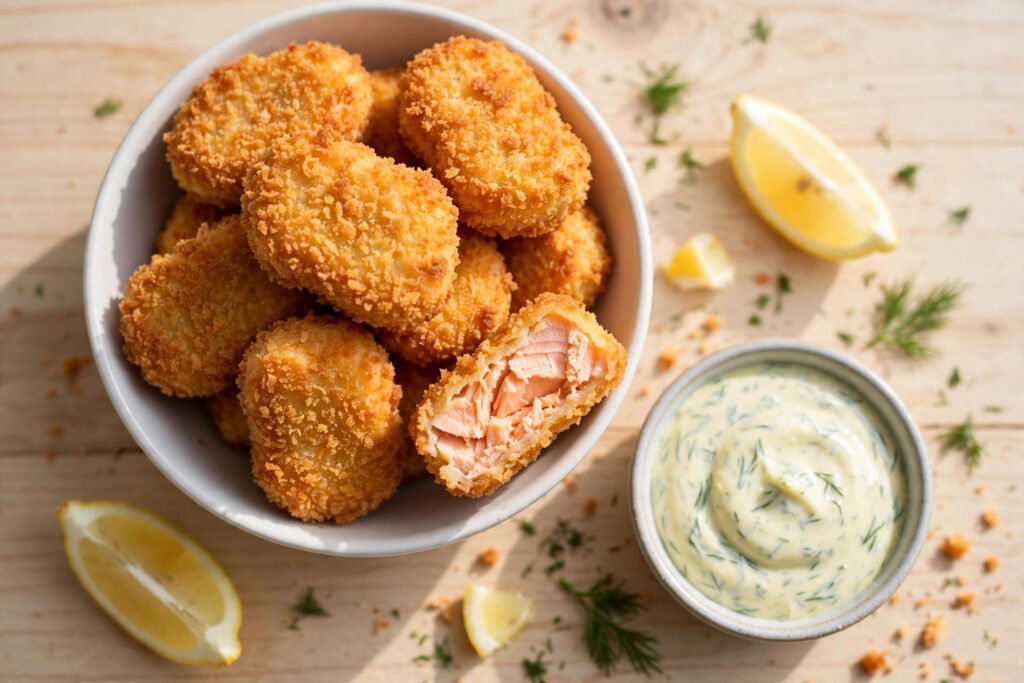
Why You’ll Love These Crispy Air Fryer Salmon Nuggets
- Ready in about 20 minutes: Faster than ordering takeaway, and most of that time is hands-off while the air fryer works.
- Genuinely crispy, barely any oil: A light spray of oil is all the coating needs — the air fryer does the crisping, not a pot of hot fat.
- High in protein: Around 24 grams of protein per serving, plus omega-3 fats that salmon is famous for.
- Kids actually eat them: Nugget-shaped, crunchy, dippable — this is the recipe that turns “I don’t like fish” into “can I have more?”
- No fishy smell in the house: The air fryer contains the cooking smell far better than pan-frying, and the basket cleans up in minutes.
- Endlessly dippable: Honey mustard, tartar sauce, sweet chilli, garlic aioli — the nuggets are a blank canvas for whatever sauce you love.
- Perfect for meal prep: Cook a batch, keep them in the fridge, and reheat them in the air fryer for two minutes to bring the crunch back.
- Works as dinner, lunch or party food: Serve with rice and vegetables, tuck into wraps, or set out with toothpicks and sauces.
- Naturally dairy-free option: Skip the parmesan in the coating and use a dairy-free dip — the recipe adapts without losing anything.
What Exactly Are Crispy Air Fryer Salmon Nuggets?
A crispy air fryer salmon nugget is a bite-sized cube of salmon fillet, coated in seasoned breadcrumbs and cooked in an air fryer until the outside is golden and crunchy and the inside is moist and flaky. The concept borrows its shape from the chicken nugget — small, dippable, easy to eat with your fingers — but the filling is real fish, not processed meat, and the flavour is richer and more interesting than anything that comes out of a freezer bag.
The nuggets start with a proper salmon fillet, cut into even cubes of about 2.5 cm. Each cube goes through a three-step coating: a light dusting of seasoned flour, a dip in beaten egg, and a roll in panko breadcrumbs mixed with garlic powder, paprika, salt and pepper. The flour helps the egg stick, the egg helps the crumbs stick, and the panko — those light, flaky Japanese breadcrumbs — is what gives the finished nugget its shattering, golden crust.
They are not fish fingers. Fish fingers are made from minced fish pressed into shape; salmon nuggets are whole cubes of fillet, so every bite has the texture of real salmon — flakes that separate cleanly, a buttery richness, and a centre that stays juicy because the cube is thick enough to protect itself from the heat.
The air fryer is the third ingredient, in a sense. It cooks by blasting the nuggets with fast-moving hot air, which crisps the coating on all sides at the same time — hard to achieve in a pan, where the side touching the heat crisps and the side facing up steams. That is why these nuggets come out evenly golden, with so little oil: the hot air does the work a pool of oil would otherwise do.
If you already enjoy air fryer cooking, you will recognise the same logic behind our Air Fryer Sourdough Pizza Toast. That recipe uses the air fryer to turn bread crisp and cheese bubbly in minutes, with almost no washing up. These salmon nuggets use the same principle — high heat, fast air, a short cook — applied to fish, and the result is the same kind of quick, satisfying, weeknight-friendly food.
Why the Air Fryer Works So Well for Salmon Nuggets
Salmon is a fish that punishes overcooking quickly and rewards speed. A fillet that spends too long on the heat dries out, turns chalky, and loses the buttery texture that makes salmon worth buying. The air fryer is good for salmon precisely because it is fast: at 200°C (400°F), a 2.5 cm cube of salmon reaches its safe internal temperature of 63°C (145°F) in eight to ten minutes, and the coating is crisp by the same moment the fish is done. The timing lines up beautifully, which is not something you can say for every cooking method.
The second advantage is the evenness of the heat. An air fryer is a small, enclosed space with a fan that pushes hot air around the food constantly. Every nugget gets the same blast of heat from every direction, so the coating browns evenly and the fish cooks through at the same rate. In an oven, the nuggets on the edge of the tray cook faster than the ones in the middle, and the bottoms stay pale unless you flip them. In a pan, the bottoms crisp and the tops steam. The air fryer removes both problems.
The third advantage is oil — or rather, the lack of it. Deep frying salmon nuggets means heating a litre of oil, dealing with splatter, and ending up with food that has absorbed a significant amount of fat. Pan-frying uses less oil but still leaves the coating greasy where it sat in the fat. Air frying needs only a light spray of oil over the crumbs, just enough to help them brown and turn golden. The finished nuggets taste rich because salmon itself is a rich fish, not because they are carrying extra oil.
One honest note: an air fryer is not magic, and it has a limit that matters for this recipe. The nuggets must cook in a single layer, with a little space between them, or the hot air cannot reach all sides and the coating steams instead of crisping. If your basket is small, cook in two batches rather than crowding them in. The second batch takes the same eight to ten minutes, and the first batch stays hot and crisp on a wire rack while it waits.
How Crispy Does the Coating Get?
Properly crisp, with a crunch you can hear. Panko breadcrumbs are the reason: unlike fine breadcrumbs, which form a dense, uniform shell, panko is made from crustless bread baked into large, airy flakes. Those flakes crisp into an irregular, jagged coating with lots of edges, and every one of them goes golden and crunchy in the hot air — a crust that shatters when you bite it, not the soft, bready coating fine breadcrumbs give.
That said, the crispiness depends on a few choices you make, and it is worth understanding them before you start, because each one moves the result.
| Choice | What it does | Best for maximum crunch |
|---|---|---|
| Panko breadcrumbs | Large, airy flakes that crisp into a jagged golden crust | Yes — the single biggest factor |
| Fine breadcrumbs | Dense, even coating that browns but stays softer | A smoother, more uniform crust |
| Crushed crackers | Buttery flavour, medium crunch | A rich, savoury coating |
| Cornflakes, crushed | Very crunchy, slightly sweet | A fun, extra-crispy variation |
| Almond flour | Light, nutty coating, gluten-free | A lighter, delicate crunch |
| No coating (bare salmon cubes) | The fish itself crisps lightly at the edges | Not crispy — skip if crunch is the point |
The oil spray matters more than most people expect. Panko straight out of the packet is dry and pale, and dry panko browns slowly and unevenly. A light, even spray of oil over the coated nuggets gives the hot air something to work with, and the crumbs turn deep golden instead of staying pale and floury. A spray bottle or mister gives the most even coverage; a light brush with a pastry brush works too.
Spacing matters as well. Nuggets that touch each other in the basket steam where they touch, and steamed panko is soggy panko. Leave a finger’s width between the cubes, and the hot air can reach every side. If you need to cook more than one layer’s worth, do it in batches — the first batch holds its crunch perfectly on a wire rack in a warm oven while the second batch cooks.
The coating is at its crispiest in the first ten minutes after cooking, when the contrast between the hot, shattering crust and the tender salmon inside is at its best. Serve the nuggets as soon as they have rested for two minutes, with the sauces already on the table.
Choosing Your Salmon: Fresh vs Frozen, Wild vs Farmed
The salmon you buy is the single biggest factor in how these nuggets taste, so it is worth choosing well. You do not need the most expensive fillet in the shop — you need one that is fresh, reasonably thick and free of pin bones. The centre-cut piece, the thick middle of the fillet, is ideal for nuggets because it gives you even cubes that cook at the same rate.
Fresh salmon is the simplest choice. Look for fillets that are bright in colour — coral pink for Atlantic salmon, a deeper red-orange for sockeye — with a clean smell of the sea rather than a strong fishy odour. The flesh should spring back when pressed gently, and the surface should look moist, not dry or dull. Ask the fish counter to remove the pin bones if you would rather not do it yourself.
Frozen salmon works well too, and it is often the more practical choice — usually frozen within hours of being caught, so it can be fresher, in the practical sense, than a “fresh” fillet that has spent days travelling. Thaw it slowly in the fridge overnight, then pat it very dry before cutting. Salmon thawed in a hurry under running water, or cooked from partially frozen, releases too much moisture and the coating will not stick.
Wild versus farmed is a question of flavour, fat and budget, and there is no wrong answer. Here is an honest comparison.
| Farmed Atlantic salmon | Wild salmon (sockeye, coho) | |
|---|---|---|
| Flavour | Mild, buttery, gentle | Stronger, more distinctly “salmon” |
| Fat content | Higher — richer, more forgiving | Leaner — cooks faster, dries out sooner |
| Colour | Coral pink, consistent | Deep red-orange |
| Texture | Soft, almost creamy when cooked | Firmer, with a more pronounced flake |
| Price | Usually cheaper per kilo | Usually more expensive |
| Availability | Year-round, everywhere | Seasonal, varies by region |
| Best for nuggets | Excellent — the extra fat keeps cubes juicy | Very good — cut cubes slightly larger to protect them |
For nuggets, farmed Atlantic salmon is the easier choice. Its higher fat content is forgiving — the cubes stay juicy even if you overshoot by a minute — and the mild flavour is what children and fish-sceptics prefer. Wild salmon makes superb nuggets too, with a more pronounced flavour and spectacular colour, but cut the cubes a little larger, about 3 cm, and pull them at eight minutes rather than ten.
Avoid the thin tail end of a fillet: those pieces cook in half the time of the thick ones, leaving a mix of perfect cubes and dried-out ones. Cut the tail off and save it for another dish — a quick pan-fry with soy and ginger, for example — and use the thick centre for your nuggets.
Should You Remove the Skin?
Yes, for nuggets. The skin is wonderful crisped in a pan, but inside a breadcrumb coating it turns soft and chewy, and it stops the crumbs from sticking. Removing it is easy: lay the fillet skin-side down, slide a sharp knife between skin and flesh at one corner, grip the skin with kitchen paper, and slide the knife along the board while pulling the skin towards you. It takes thirty seconds once you have done it once — or ask the fish counter, for whom it is a standard request.
Can I Use Frozen Salmon?
Yes, with one condition: it must be fully thawed and thoroughly dried. Thaw it overnight in the fridge, still in its packaging, on a plate to catch any liquid. Then unwrap it and pat both sides dry on kitchen paper — twice. Salmon holds a surprising amount of surface moisture, and wet salmon is the enemy of a coating that sticks. If the cubes feel slippery, the flour, egg and panko will all slide off in the basket. Dry fish takes the coating beautifully.
How Much Protein Is in Salmon Nuggets?
Salmon is one of the best protein sources you can put on a plate, and these nuggets deliver it in a form that is easy to eat and easy to enjoy. A 100-gram portion of cooked Atlantic salmon contains roughly 20–22 grams of protein, according to USDA nutrition data, along with a meaningful amount of omega-3 fatty acids — the EPA and DHA that salmon is famous for — plus vitamin D, vitamin B12, selenium and potassium. The nugget format does not change any of that; it just makes the salmon easier to portion and more fun to eat.
Here is the honest breakdown for one serving of this recipe as written — about six nuggets, made from 150 grams of salmon per person, with the coating included.
| Component | Amount per serving | Protein (approx.) |
|---|---|---|
| Salmon (150 g raw, about 120 g cooked) | 6 nuggets | 22 g |
| Panko breadcrumbs (2 tablespoons) | Coating | 1 g |
| Egg (1/4 of a large egg) | Coating | 1 g |
| Parmesan in the coating | 1 tablespoon | 1 g |
| Flour | Dusting | Negligible |
| Total | About 24 g |
That 24-gram figure is approximate — your salmon’s exact fat and protein content varies with the fish, and your coating thickness varies with your hand — but the order of magnitude is right. For comparison, a serving of chicken nuggets of the same weight typically lands at 14–18 grams of protein, with more saturated fat and far less omega-3. The salmon version is not just a fish-flavoured copy of a chicken nugget; nutritionally, it is a clear step up.
The omega-3 content is worth a mention too: a serving of salmon provides roughly 1.5–2 grams of EPA and DHA combined. That is not a reason to eat salmon nuggets every night — variety matters in any diet — but it is a good reason to feel pleased when the family asks for them twice in one week.
One honest note: the calories and protein here are estimates based on standard USDA values. Your exact figures will differ slightly with the size of your cubes, how much coating sticks, and how much oil you spray. Treat them as a useful guide, not a laboratory measurement.
What to Serve with Salmon Nuggets
Salmon nuggets are flexible in a way that few main dishes are. They work as the centre of a proper dinner, as the filling in a wrap or a bowl, or as finger food on a party table — and the right accompaniment changes with the role you give them.
For a full weeknight dinner, the simplest pairing is rice and a green vegetable: steamed jasmine rice, broccoli or green beans, and a wedge of lemon. The rice catches any sauce, the vegetables add freshness and crunch, and the lemon brightens the richness of the salmon. If you like bowl-style dinners, the build-your-own logic of our High Protein Chicken Burrito Bowls works beautifully here too — swap the chicken for salmon nuggets and keep the rice, beans and fresh toppings.
For a lighter meal, serve the nuggets over a big salad — mixed leaves, cucumber, cherry tomatoes, shredded carrot and a lemony dressing, with the hot nuggets on top. The contrast between warm, crunchy fish and cool, crisp salad is genuinely good on a hot evening, when a heavy dinner feels wrong. A creamy coleslaw works in the same way.
For lunch, tuck the nuggets into warm wraps or soft rolls with shredded lettuce, sliced cucumber and a spoonful of tartar sauce or garlic aioli. It travels well for a packed lunch if you keep the sauce separate and add it just before eating. The nuggets also work cold the next day, sliced into a grain salad, although they lose their crunch in the fridge — a two-minute blast in the air fryer brings it back.
For a party, serve them as finger food with toothpicks and three sauces in small bowls — honey mustard, sweet chilli and tartar sauce is a good trio, giving people a sweet, a spicy and a creamy option. Set them out on a platter with lemon wedges and chopped parsley, and they will be the first thing to disappear. Our Hot Honey Chicken Rice Bowls use the same sweet-heat logic as the honey mustard dip, so if your family likes that combination, they will love it here too.
For something starchy on the side, the classics all work: chips or sweet potato fries, roasted new potatoes with herbs, or a simple potato salad. The nuggets are rich enough that the side should be simple — the fish is the star, and the side supports it rather than competing with it.
Ingredients for Crispy Air Fryer Salmon Nuggets
Everything below makes four servings of about six nuggets each — a family dinner, or two people with generous leftovers. Halve it for two, double it for a crowd and cook in batches. The seasoning is measured for this amount of salmon, so scale it with the fish. The dipping sauce is optional but very much worth making — it takes two minutes and it is the thing people remember.
🐟 Crispy Air Fryer Salmon Nuggets Recipe Card
Golden, shatteringly crisp salmon bites with a tender, flaky centre — air-fried in about 20 minutes with barely any oil, and served with a quick honey mustard dip.
| Prep | Cook | Total | Servings |
|---|---|---|---|
| 10 minutes | 8–10 minutes | About 20 minutes | 4 servings |
📝 Recipe Overview
| Recipe name | Crispy Air Fryer Salmon Nuggets |
| Prep time | 10 minutes |
| Cooking time | 8–10 minutes |
| Total time | About 20 minutes |
| Servings | 4 servings (about 6 nuggets each) |
| Cooking method | Air fryer at 200°C (400°F) |
| Difficulty | Easy |
| Flavor | Savoury, buttery salmon with a garlicky, lightly spiced golden crunch |
| Texture | Crisp panko outside, tender and flaky salmon inside |
| Calories | About 320–360 per serving (nuggets only) |
| Protein | About 24 g per serving |
| Main allergens | Fish (salmon), egg, wheat (panko and flour), milk (parmesan) |
🍽️ Ingredients
For the salmon and coating:
- 600 g skinless salmon fillet, centre-cut: The thick middle of the fillet, which gives even cubes that cook at the same rate. Remove any pin bones and pat very dry before cubing.
- 60 g plain flour (about 1/2 cup): The first layer — it gives the egg something to grip and keeps the crumbs from sliding off.
- 2 large eggs, beaten: The glue that holds the panko to the salmon — beat well so the coating goes on evenly.
- 120 g panko breadcrumbs (about 2 cups): The crunch — large, airy flakes that crisp into a jagged golden crust fine breadcrumbs cannot match.
- 30 g finely grated parmesan (about 1/4 cup): Mixed into the panko for savoury depth and extra browning; fine grating distributes it evenly.
- 1 teaspoon garlic powder: The main savoury note. Powder, not fresh garlic — fresh garlic burns at air fryer temperatures and turns bitter.
- 1 teaspoon smoked paprika: Gives the coating its warm colour and a gentle smoky flavour; sweet paprika works, but smoked makes the crust special.
- 1/2 teaspoon onion powder: Rounds out the garlic and adds a savoury base note to the crumbs.
- 1 teaspoon fine sea salt: Divided — half for the salmon, half for the coating. The coating needs its own salt, or the crust tastes bland no matter how well the fish is seasoned.
- 1/2 teaspoon black pepper: Freshly ground if you have it. Half for the salmon, half for the coating.
- 1/2 teaspoon dried oregano: A quiet herbal note in the coating that keeps the seasoning from tasting flat.
- Olive oil spray or a light brush of olive oil: Just enough to dampen the crumbs so they brown. A spray bottle or mister gives the most even coverage.
For the honey mustard dipping sauce:
- 4 tablespoons mayonnaise: The creamy base — use a good-quality one, as it is half the sauce.
- 2 tablespoons Dijon mustard: The sharp, tangy backbone, with bite but without yellow mustard’s harshness.
- 1 tablespoon honey: The sweetness that balances the mustard; warm it briefly if thick, so it mixes smoothly.
- 1 teaspoon lemon juice: Freshly squeezed. It brightens the sauce and keeps it from tasting heavy.
- 1/4 teaspoon garlic powder: A quiet savoury note that ties the sauce to the seasoning on the nuggets.
To serve:
- 1 lemon, cut into wedges: For squeezing over the hot nuggets — the acidity is not optional, it is what makes the richness of the salmon sing.
- 2 tablespoons chopped fresh parsley: Scattered over the finished nuggets for colour and a fresh, green note.
Equipment
- An air fryer with a basket or tray
- A sharp knife and a chopping board
- Three shallow bowls or plates, for the flour, egg and panko
- Kitchen paper, for patting the salmon dry
- Tongs, for turning the nuggets
- An instant-read thermometer (recommended — it takes the guesswork out of salmon)
- A wire rack, for resting the nuggets so the coating stays crisp
- A small bowl, for mixing the dipping sauce
⭐ Ingredient Tip: The most important choice is the salmon itself — and the most important step is drying it. Salmon holds a surprising amount of surface moisture, and wet salmon sheds its coating. After cubing, lay the pieces on kitchen paper and pat the tops dry; if the cubes feel tacky rather than slippery, they are ready. A cheap instant-read thermometer is the second-best investment: salmon is done at 63°C (145°F), and the difference between perfectly juicy and dry is only a few degrees.
Quick Instructions
- Cut the salmon into 2.5 cm cubes, season with salt and pepper, and pat very dry with kitchen paper.
- Set up three shallow bowls: seasoned flour, beaten eggs, and panko mixed with parmesan, garlic powder, paprika, onion powder, salt, pepper and oregano.
- Coat each cube in flour, then egg, then panko, pressing the crumbs on gently so they stick.
- Preheat the air fryer to 200°C (400°F) for 3 minutes. Lightly spray the basket with oil.
- Arrange the nuggets in a single layer with space between them. Spray the tops lightly with oil.
- Air fry for 8–10 minutes, flipping halfway, until deep golden and the salmon reaches 63°C (145°F).
- Rest on a wire rack for 2 minutes. Mix the honey mustard sauce while the nuggets cook, and serve hot with lemon wedges.
How to Make Crispy Air Fryer Salmon Nuggets Step by Step
Step 1: Prepare the Salmon and Cut It into Cubes
Start with the salmon, because everything else follows from how you cut it. Lay the fillet skin-side down and run your fingers along the flesh to feel for pin bones — thin, flexible bones running in a line down the centre. Pull any you find out with clean tweezers, in the direction the bone points. Most fish counters will do this for you if you ask.
If the fillet still has skin, remove it now: slide a sharp knife between skin and flesh at one corner, grip the skin with kitchen paper, and slide the knife along the board while pulling the skin towards you, keeping the knife flat so you lose as little flesh as possible. It takes about thirty seconds.
Pat the fillet very dry with kitchen paper — both sides, and then again. This is the step that decides whether your coating stays on or falls off. Cut the fillet into even cubes of about 2.5 cm; a much smaller cube overcooks while the larger ones are still coming up to temperature. Cut off the thin tail end and save it for another dish. Season the cubes with half a teaspoon of salt and a quarter teaspoon of black pepper, tossing gently so the seasoning reaches every piece.
Step 2: Set Up the Three-Bowl Coating Station
A coating station is one of those things that sounds fussy and turns out to be the reason the job goes quickly and cleanly. Set out three shallow bowls or plates in a row, and arrange them left to right in the order you will use them: flour, egg, panko. Shallow is important — a deep bowl makes it hard to roll a cube evenly, and you end up with crumbs on your fingers and bare patches on the fish.
In the first bowl, put the flour with a pinch of salt and pepper. In the second, beat the two eggs until yolks and whites are fully combined with no streaks left — an unevenly beaten egg coats unevenly. In the third, combine the panko, parmesan, garlic powder, smoked paprika, onion powder, remaining salt and pepper, and oregano, and mix with a fork until the colour is even and the parmesan is distributed rather than clumped.
Keep one hand dry and one hand wet if you can: one hand for flour and egg, the other for panko. It is the difference between a clean coating station and fingers that gradually acquire their own breadcrumb armour. If both hands end up coated, rinse and dry them before the next batch.
Step 3: Coat the Salmon Cubes
Work through the cubes one at a time — a careful coating now gives you a golden, even crust later. Roll a cube in the flour until dusted all over, then shake off the excess. Too much flour is as bad as too little: a thick layer turns gummy under the egg and stops the crumbs gripping. You want a thin, even dusting, just enough to make the surface look matte.
Drop the floured cube into the beaten egg and turn it once or twice so it is coated on all sides. Lift it out and let the excess drip off — wet enough for the crumbs to stick, not dripping. Roll it in the panko, pressing the crumbs on gently so they adhere, then turn it over and press again so every face is covered. A nugget with a bare patch leaks moisture and goes soggy in that spot, so check each one before setting it aside.
Place the coated cubes on a plate or a tray lined with baking paper, with space between them. They can sit for a few minutes while you finish — the coating adheres better after a short rest, as the egg hydrates the crumbs slightly. For a double batch, keep them in a single layer rather than stacking, or the crumbs stick together and pull off.
Step 4: Preheat the Air Fryer and Arrange the Nuggets
Preheat the air fryer to 200°C (400°F) for three minutes. Preheating matters more here than for many air fryer recipes, because the coating needs to hit hot air immediately. In a cold basket the crumbs warm slowly, absorb moisture from the fish, and never quite crisp; a hot basket starts crisping the coating the moment the nuggets land.
Lightly spray the basket with oil, or brush it with a thin layer using a pastry brush. This is not about adding fat to the food — it is about stopping the crumbs from sticking to the basket and tearing off when you flip the nuggets. A light coating of oil on the metal is enough; you do not need a pool of it.
Arrange the nuggets in a single layer with a finger’s width of space between them. This is the rule that matters most, and the one people break most often: nuggets that touch steam where they touch, and steamed panko is soggy panko. If your basket is small, cook in two batches — the first holds its crunch on a wire rack while the second cooks. Once the nuggets are in, spray the tops lightly with oil, just enough to dampen the crumbs so they brown evenly.
Step 5: Air Fry Until Golden and Crisp
Slide the basket in and cook for 8–10 minutes, flipping once at the halfway mark. Flipping gives you an evenly golden crust on all sides; do it carefully with tongs rather than shaking the basket, which can knock the coating loose. Tongs let you turn each nugget individually and check the browning as you go.
The nuggets are done when the coating is deep golden and the salmon inside has reached 63°C (145°F) at the centre of the thickest cube. Use an instant-read thermometer if you have one, inserting the probe into the centre of a cube from the side. Without one, cut the thickest nugget open: the salmon should be opaque and flake easily, with no translucent centre, and still look moist and slightly glossy. Dry and chalky means it has gone a minute too far.
Cooking time varies with cube size and air fryer power: 2.5 cm cubes usually need eight to ten minutes, 3 cm cubes ten to eleven. Start checking at eight minutes and pull the nuggets the moment they are done — salmon goes from perfect to overcooked in about sixty seconds, and there is no way back once it has dried out. If your air fryer runs hot and the coating browns before the fish is done, drop the temperature to 190°C (375°F) for the second batch.
Step 6: Rest the Nuggets on a Wire Rack
Transfer the nuggets to a wire rack — not a plate — and leave them for two minutes. The rest lets the salmon finish cooking gently from its own residual heat, and the rack lets air circulate underneath, so the coating stays crisp on the bottom instead of steaming against a flat plate. A plate traps steam, and steam is the enemy of crunch.
While the nuggets rest, finish the table: sauce in small bowls, lemon cut into wedges, parsley scattered, sides out. Two minutes is exactly enough, and the nuggets will be at their best — hot, crisp, just cool enough to pick up — the moment you sit down.
Step 7: Make the Honey Mustard Sauce and Serve
The sauce takes two minutes and is worth making fresh rather than reaching for a bottle. Whisk the mayonnaise, Dijon mustard, honey, lemon juice and garlic powder until smooth. It should be creamy and tangy, the honey softening the mustard’s bite and the lemon keeping it bright. Sweeter? Add another half teaspoon of honey. Sharper? Another squeeze of lemon. It keeps for three days in the fridge, so you can make it ahead.
Serve the nuggets hot, on a platter or in a wide bowl, with the sauce in small bowls alongside, lemon wedges for squeezing, and chopped parsley scattered over the top. Squeeze lemon over the nuggets just before eating — the acidity cuts through the richness of the salmon. Hand everyone a fork or a toothpick, put the sauces in the middle of the table, and let people help themselves. The nuggets are at their crispiest in the first ten minutes, so do not let them sit around waiting for a photograph.
The Seasoning Blend: Why It Works
The coating seasoning looks simple, but each ingredient earns its place. Garlic powder gives the savoury backbone — used instead of fresh garlic, which burns at 200°C and turns bitter. Smoked paprika brings colour and a gentle smokiness that makes the crust taste like it came off a grill. Onion powder rounds out the garlic, oregano adds a herbal note, and the parmesan adds salt, savoury depth and extra browning.
Salt is doing quiet work in both the fish and the coating — season only one and the other tastes bland, which is why the recipe divides it between the salmon and the panko. If you make the coating ahead, mix the dry spices and store them in a small sealed jar; they keep for months, and the same blend is excellent on chicken, white fish and roasted chickpeas.
Tips for the Best Salmon Nuggets
Pat the salmon dry — twice. Surface moisture is the enemy of a coating that sticks. Dry the fillet before cubing, and dry the cubes again before coating. If the fish feels slippery, the crumbs will slide off in the basket.
Keep the nuggets in a single layer. Crowded nuggets steam instead of crisping. Cook in batches if your basket is small; the first batch stays crisp on a wire rack while the second cooks.
Use a thermometer, not a timer. Cubes vary in size, and air fryers vary in power. Salmon is done at 63°C (145°F) — temperature is the only measurement that tells you the truth.
Spray the crumbs, not the basket alone. A light spray of oil over the coated nuggets is what turns pale panko deep golden. A dry coating browns slowly and unevenly.
Serve them immediately. The coating is at its crispiest in the first ten minutes. Have the sauces, lemon and sides ready before the nuggets come out, so nothing waits.
Do not overcook them. Salmon goes from perfect to dry in about sixty seconds. Start checking at eight minutes, and pull the nuggets the moment they reach temperature.
Troubleshooting: What Went Wrong and How to Fix It
| Problem | Likely cause | Fix |
|---|---|---|
| Coating fell off in the basket | Salmon was wet, or flour layer too thick | Pat the salmon very dry; shake off excess flour |
| Coating is pale, not golden | No oil spray, or basket not preheated | Spray the crumbs lightly with oil; preheat 3 minutes |
| Nuggets are soggy underneath | Cooked on a plate, or basket crowded | Rest on a wire rack; cook in a single layer with space |
| Salmon is dry | Overcooked by a minute or two | Use a thermometer; pull at 63°C (145°F) |
| Nuggets stuck to the basket | Basket not oiled | Lightly spray or brush the basket before adding the nuggets |
| Coating is patchy | Egg not beaten evenly, or crumbs not pressed on | Beat the egg fully; press the panko on gently with your fingers |
| Nuggets taste bland | Coating not salted | Salt the panko mixture as well as the salmon |
| Some nuggets overcooked, some underdone | Cubes were uneven sizes | Cut cubes to an even 2.5 cm; set thin tail pieces aside |
Variations to Try
Spicy salmon nuggets: Add 1/2 teaspoon of cayenne pepper and 1/4 teaspoon of chilli flakes to the panko, and serve with sweet chilli sauce. The heat builds gently against the richness of the salmon.
Lemon herb salmon nuggets: Add the zest of one lemon and a tablespoon of chopped fresh dill to the panko, and swap the honey mustard for tartar sauce. Bright, fresh and perfect for summer.
Asian-style salmon nuggets: Add 1 teaspoon of ground ginger and 1/2 teaspoon of five-spice powder to the coating, serve with a soy and honey dip, and sprinkle sesame seeds into the panko for extra crunch.
Gluten-free salmon nuggets: Swap the flour for rice flour and the panko for gluten-free panko or crushed cornflakes; check the parmesan and spices are certified gluten-free. The method and timing stay the same.
Baked salmon nuggets (no air fryer): Bake on a wire rack over a baking tray at 220°C (425°F) for 12–14 minutes, flipping halfway. The rack is essential — without it, the bottoms steam. Very good, though slightly less evenly crisp than the air fryer version.
Salmon nugget tacos: Pile the hot nuggets into warm corn tortillas with shredded cabbage, pickled red onion and a drizzle of chipotle crema — the same recipe, served as taco night.
Toppings and Dips: Build Your Sauce Bar
The nuggets are a blank canvas for sauces, and setting out two or three in small bowls turns a simple dinner into something that feels like an event. The honey mustard in the recipe card is the house favourite, but these all work.
Creamy: Tartar sauce, garlic aioli, ranch dressing, or a lemon and herb yoghurt dip from Greek yoghurt, lemon zest and chopped dill. One creamy sauce per meal is enough — two starts to feel heavy.
Sweet and sticky: Sweet chilli sauce, honey mustard, or a barbecue sauce thinned with lemon juice. Sweetness against the savoury, salty coating works far better than it sounds.
Spicy: Sriracha mayonnaise, chipotle crema, or a hot sauce on the side. Always serve extra heat on the side when cooking for a group — easy to add, impossible to take away.
Fresh: A salsa of diced tomato, red onion, coriander and lime, or a cucumber and mint yoghurt. Fresh toppings add crunch and brightness against the rich, crisp fish.
The only rule is balance: one creamy sauce, one sweet or spicy sauce, and something fresh. More than that and the table gets cluttered; less, and people run out of choices before they run out of nuggets.
Meal Prep and Storage
These nuggets were built for busy weeks, and they reheat better than almost any fried food — provided you reheat them the right way.
In the fridge: Cooked nuggets keep for 3 days in a sealed container. Cool them completely on a wire rack first, or trapped steam softens the coating. Store the sauce separately; it keeps for 3 days too.
Reheating: The air fryer is the only method that brings the crunch back: 190°C (375°F) for 2–3 minutes, in a single layer, and the coating crisps almost as well as fresh. The microwave is the enemy here — it makes the coating soft and the salmon rubbery in under a minute. Without an air fryer, a hot oven at 200°C (400°F) for 5 minutes on a wire rack is the next best option.
In the freezer: Uncooked, coated nuggets freeze well for up to 1 month — freeze in a single layer on a tray until solid, then transfer to a freezer bag, and cook from frozen at 200°C (400°F) for 12–14 minutes, flipping halfway. Cooked nuggets freeze too, but lose a little crunch; reheat from frozen in the air fryer at 190°C (375°F) for 4–5 minutes.
Making ahead for a party: Coat the nuggets up to 4 hours ahead and keep them uncovered in the fridge on a tray lined with baking paper — the dry fridge air helps the coating set. Cook in batches just before serving, keeping finished batches warm on a wire rack in a low oven at 100°C (200°F).
Nutrition Notes
Each serving comes in at roughly 320–360 calories, with about 24 grams of protein, 14–16 grams of carbohydrate, 2 grams of fibre and 16–18 grams of fat. The fat is mostly the good kind — omega-3s from the salmon and monounsaturated fat from the olive oil — and the protein comes almost entirely from the fish.
To lighten the serving, skip the parmesan and use a little less panko — it drops to roughly 280–300 calories with the protein barely touched. For a richer version, add a spoonful of aioli or an extra drizzle of honey mustard, and it climbs to about 420 calories. Same recipe, same effort, different meals depending on what your day needs.
One honest note: sodium is moderate, around 500–600 mg per serving, mostly from the salt in the coating and the parmesan. Watching sodium? Cut the salt in the coating by a third and choose a low-sodium dip; the nuggets still taste well seasoned because the salmon itself is seasoned separately.
Frequently Asked Questions
Can I use frozen salmon for salmon nuggets?
Yes, as long as it is fully thawed and thoroughly dried. Thaw it overnight in the fridge, then pat it very dry with kitchen paper before cutting into cubes. Partly frozen salmon cooks unevenly, and wet salmon sheds its coating. Frozen salmon is often frozen within hours of being caught, so it can be an excellent choice.
How do I know when salmon nuggets are done?
Temperature is the reliable test: 63°C (145°F) at the centre of the thickest cube, measured with an instant-read thermometer. Without one, cut the thickest nugget open — the salmon should be opaque, flake easily, and still look moist, with no translucent centre. Dry and chalky means it has gone a minute too far.
Can I make salmon nuggets without an air fryer?
Yes. Bake on a wire rack over a baking tray at 220°C (425°F) for 12–14 minutes, flipping halfway — the rack is essential so hot air reaches the bottoms. You can also pan-fry in a thin layer of oil over medium-high heat for 2–3 minutes per side, though the coating will be less evenly crisp.
Why did my coating fall off?
Almost always because the salmon was wet. Pat the fillet dry before cubing and dry the cubes again before coating, and shake off excess flour — a thick flour layer turns gummy and lets go. Pressing the panko on gently helps the crumbs grip, and a short rest after coating lets the egg hydrate the crumbs, improving adhesion.
How long do salmon nuggets last in the fridge?
Cooked nuggets keep for 3 days in a sealed container. Cool them completely on a wire rack before packing away, and store the sauce separately. Reheat in the air fryer at 190°C (375°F) for 2–3 minutes — avoid the microwave, which makes the coating soft.
Are salmon nuggets gluten-free?
Not as written, because the coating uses wheat flour and panko. Swap the flour for rice flour and the panko for gluten-free panko or crushed cornflakes, and check the parmesan and spice blends are certified gluten-free. The method and cooking time stay the same.
What is the best dipping sauce for salmon nuggets?
Honey mustard is the classic pairing — sweet, tangy and creamy against the savoury crunch. Tartar sauce is the traditional fish-shop choice, garlic aioli adds richness, and sweet chilli is the one children usually reach for first. Put two or three on the table; the nuggets are good with all of them.
Can I use a different fish for nuggets?
Yes. Cod, haddock and pollock all work, cut into the same 2.5 cm cubes — they are leaner than salmon, so check them a minute earlier, at 7–8 minutes. Prawns work too, coated the same way and cooked for 5–6 minutes. Same method; only the fish and the timing change.
Conclusion
Crispy air fryer salmon nuggets are the kind of recipe that quietly changes how often fish appears on your table. Fast enough for a Tuesday, good enough for a Saturday, and friendly enough that even the fish-sceptics will ask for seconds. The coating shatters, the salmon inside stays tender and buttery, and the whole thing takes about twenty minutes with barely any oil and almost no washing up.
Make them once exactly as written — same cube size, same coating, same temperature — and learn how your air fryer and your salmon behave together. Then make them yours: turn up the heat with cayenne, swap in a lemon and dill coating, or pile them into tacos on a Friday night. The base recipe is forgiving, the nuggets reheat beautifully, and a batch cooked on Sunday makes lunches worth looking forward to all week.
If you enjoy air fryer cooking, our Air Fryer Sourdough Pizza Toast uses the same quick, crisp, low-effort logic for a different snack. And if bowl-style dinners are your thing, our High Protein Chicken Burrito Bowls follow the same build-it-your-way spirit. These salmon nuggets are the crunchy, dippable, twenty-minute member of the family — and once you have made them, they are the ones you will come back to most.
Sources
- Wikipedia — Salmon as food: https://en.wikipedia.org/wiki/Salmon_as_food
- Wikipedia — Air fryer: https://en.wikipedia.org/wiki/Air_fryer
- USDA FoodData Central — Atlantic salmon nutrition data: https://fdc.nal.usda.gov/
- USDA Food Safety and Inspection Service — Safe minimum internal temperatures: https://www.fsis.usda.gov/food-safety/safe-food-handling-and-preparation/food-safety-basics/safe-temperature-chart
- Harvard T.H. Chan School of Public Health — The Nutrition Source, Fish: https://nutritionsource.hsph.harvard.edu/what-should-you-eat/fish/

2 thoughts on “Crispy Air Fryer Salmon Nuggets”