
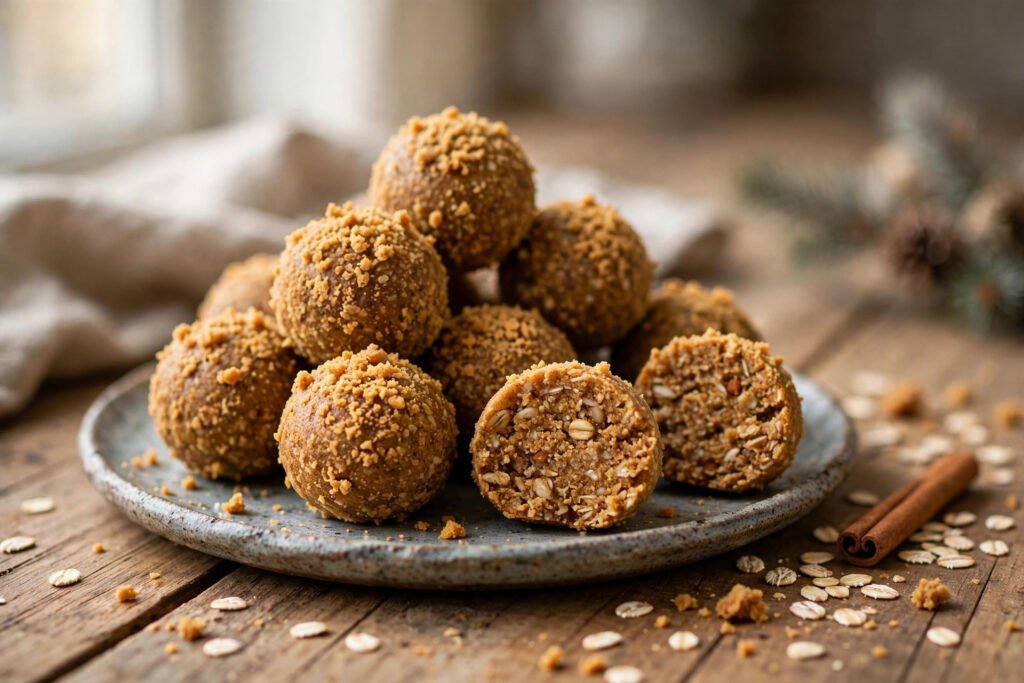
Some snacks taste like a compromise. You know the ones — the “healthy” bar that tastes like sweetened cardboard, the protein ball that is somehow both dry and sticky at the same time. This no bake gingerbread protein balls recipe is not one of those. These taste like the soft middle of a gingerbread cookie, rolled into a ball, with a little chew from the oats and a warm spice hit that lingers after you swallow. You would eat them even if nobody told you they had protein in them.
That is the test that matters. A snack that only works when you are hungry enough to ignore the taste is not a snack — it is a chore. These pass the real test: the one where you make a batch on Sunday, put them in a container in the fridge, and by Wednesday they are gone. Not because you forced yourself. Because you kept walking past the fridge.
Fifteen minutes. One bowl. No oven, no baking sheet, no mixer, no waiting for anything to cool. You stir everything together, roll it into balls, and chill them for half an hour so they firm up. That is the whole recipe. The protein comes from a scoop of vanilla protein powder and a big spoonful of nut butter, and each ball lands at about 8 grams of protein for roughly 140 calories — enough to actually hold you until lunch, not just delay the hunger by twenty minutes.
⚡ Quick Answer: Stir 1½ cups of rolled oats, ½ cup of vanilla protein powder, 1 teaspoon of ground ginger, 1 teaspoon of cinnamon, ¼ teaspoon of nutmeg, ¼ teaspoon of cloves and a pinch of salt in a bowl. Add ½ cup of natural peanut or almond butter, ⅓ cup of honey or maple syrup, 2 tablespoons of molasses, 1 teaspoon of vanilla and 2–3 tablespoons of milk. Mix until it holds together, roll into 16 balls, and chill for 30 minutes. That is it — no baking, no blender, and they keep for a week in the fridge.
TL;DR – Recipe at a Glance
- Prep time: 15 minutes
- Chill time: 30 minutes (they are edible right away, just softer)
- Total time: 15 minutes of work, 45 minutes start to finish
- Servings: 16 balls, about 30 g each
- Cooking method: None — no bake, no oven, no stove
- Difficulty: Easy — if you can stir and roll, you can make these
- Flavour: Warm gingerbread spice, molasses, vanilla, a little salt
- Texture: Soft, chewy, a little dense — like cookie dough that holds its shape
- Protein: About 8 g per ball
- Calories: About 140 per ball
- Make-ahead: Yes — a week in the fridge, three months in the freezer
Why You’ll Love These No Bake Gingerbread Protein Balls
- They taste like actual gingerbread, not like a protein bar pretending to be gingerbread: The spice blend is the real thing — ginger, cinnamon, nutmeg, cloves — plus molasses, which is where gingerbread gets its dark, almost caramel flavour. Nothing artificial.
- Fifteen minutes, one bowl, zero baking: No preheating, no pans, no timer anxiety. You mix, you roll, you chill. The hardest part is waiting the thirty minutes for them to firm up.
- 8 grams of protein per ball, and you can actually taste the food: The protein powder disappears into the oats and nut butter. No chalky aftertaste, no weird texture — just a chewy ball that happens to keep you full.
- They travel better than almost anything: No crumbs, no melting, no squashing. Toss two in a bag for the gym, the car, the office drawer, a school lunchbox. They hold their shape at room temperature for hours.
- Kids eat them without being told they are healthy: They look like cookie dough balls and taste like a holiday cookie. The oats and protein powder are invisible. If you have ever tried to get a child to eat a protein snack, you know how rare that is.
- One batch, five days of snacks: Sixteen balls is a work week of afternoon snacks. Make them on Sunday night and you are covered until Friday.
- Cheap, and you already own most of it: Oats, peanut butter, honey, cinnamon, ginger. The only thing you might need to buy is a bag of protein powder, and one bag makes about ten batches of these.
- Endlessly adjustable: Swap the nut butter, swap the sweetener, roll them in something different, add chocolate chips or dried cranberries. The base recipe is forgiving in a way most baking is not.
- No special equipment at all: A bowl, a spoon, your hands. No food processor, no mixer, no moulds. If your kitchen is small or your patience is short, this is the recipe for you.
- They freeze beautifully: Make a double batch, freeze half, and you have snacks for a month. Thaw one in your bag on the way to work and it is ready by the time you want it.
What Gingerbread Flavour Actually Is (and Why Molasses Matters)
People say “gingerbread” and mean a lot of different things. A gingerbread house. A gingerbread man with raisin eyes. A slice of dark ginger cake. But the flavour underneath all of them is the same idea: ground ginger for warmth, cinnamon for sweetness, a pinch of nutmeg and cloves for depth, and molasses for that dark, almost caramel note that makes gingerbread taste like gingerbread instead of like a spice cookie.
Molasses is the ingredient that does the most work here and gets the least credit. Two tablespoons. That is all. But without it, these balls taste like cinnamon oat balls — pleasant, a bit plain, forgettable. With it, they taste like December. Molasses brings a deep, slightly bitter sweetness that honey and maple syrup cannot give you on their own. It is the difference between a snack that tastes spiced and a snack that tastes like gingerbread.
A word on which molasses to buy. The jar labelled “unsulphured” is the one you want — it is made from ripe sugar cane, and it tastes rich and round. Blackstrap molasses is the other kind you will see on the shelf. It is thicker, darker, much more bitter, and it has a strong mineral taste that takes over a small recipe like this one. Blackstrap has its place — some people love it in baked beans or barbecue sauce — but in a protein ball it bullies every other flavour out of the way. Use unsulphured, or if your shop only stocks blackstrap, use half the amount and add an extra tablespoon of honey.
The spice amounts matter more than you would think for a no-bake recipe. In a baked cookie, the heat mellows the spices and blends them together. Here there is no heat. The spices go in raw, and they stay exactly as bold as you put them in. That is why the recipe uses a full teaspoon of ginger and a full teaspoon of cinnamon, and only a quarter teaspoon each of nutmeg and cloves. Cloves especially — a little goes a long way, and half a teaspoon of cloves in a no-bake ball will taste like a dentist’s office. A quarter teaspoon gives you the warmth without the medicine-cabinet flavour. If you love cloves, add a pinch more next time. But start here.
One more thing worth knowing: the flavour gets better overnight. The oats soften slightly, the spices bloom into the nut butter, and the molasses settles into everything. A ball eaten straight after rolling is good. A ball eaten the next day is noticeably better — rounder, warmer, more like a cookie. So if you can, make them the night before you need them. It costs you nothing and the difference is real.
The Protein Question: How Much, and Which Powder?
Let us be honest about the protein, because most protein ball recipes are vague about it in a way that is not very helpful. These have about 8 grams of protein per ball. That number comes from the protein powder (about 20–24 g per scoop, depending on the brand) plus the nut butter and the oats, divided across sixteen balls. It is not a protein shake. It is a snack with real protein in it — enough to matter, not enough to replace a meal.
Could you push it higher? Yes. Add another half scoop of protein powder and you get closer to 10 grams per ball. But there is a trade-off, and it is worth knowing before you do it: protein powder absorbs liquid, and every extra spoonful makes the mixture drier and more crumbly. At a full scoop and a half, the balls start to fall apart unless you add more milk or nut butter, and then you are adding calories back in. The recipe as written is the sweet spot — enough protein to be useful, still soft and chewy enough to enjoy eating. If you want more protein in a day, eat two balls. That is 16 grams, and it still tastes like a cookie.
The type of protein powder matters more than the brand. Whey protein and plant-based protein behave differently in a no-bake recipe, and the difference shows up in the texture. Whey — the kind made from milk — blends in smoothly and gives the balls a soft, almost fudge-like bite. It is the easiest option and the one this recipe was tested with most. Plant-based powders (pea, rice, hemp, or a blend) absorb more liquid and can taste a little gritty or earthy, especially on their own. They still work — plenty of people use them and like the result — but you will probably need an extra tablespoon of milk, and a flavoured one (vanilla or unflavoured) works better than chocolate, which fights with the gingerbread spices.
The flavour of the powder matters too. Vanilla is the right call here. It disappears into the gingerbread spices and adds a creamy background note. Unflavoured works as well, and it lets the spices speak a little louder. Chocolate protein powder is the one to avoid in this recipe — chocolate and gingerbread can work together, but in a small ball the chocolate takes over and the gingerbread becomes an afterthought. Save the chocolate powder for our Single Serve Protein Brownie, where it belongs.
What if you do not have protein powder at all? You can still make these. Leave the powder out and add an extra half cup of oats, and you get a gingerbread energy ball with about 4 grams of protein from the nut butter and oats. It is still a good snack — just not a protein snack. The texture changes slightly (a little softer, a little chewier) and you may need a touch less milk, since there is no powder soaking it up. The recipe works either way, and nobody at your table will know the difference unless you tell them.
The Recipe Card
Everything you need, in one place. The sections after this card go deeper — the spice blend, the rolling, the fixes — but if you just want to make them, this card is the whole recipe.
| Prep time | 15 minutes |
| Chill time | 30 minutes |
| Total time | 15 minutes of work, 45 minutes start to finish |
| Servings | 16 balls |
| Yield | 16 balls, about 30 g each |
| Course | Snack, dessert |
| Cuisine | American, holiday baking |
| Method | No bake — mixed and rolled by hand |
| Difficulty | Easy |
Overview
| Main ingredients | Rolled oats, vanilla protein powder, nut butter, molasses |
| Key flavour | Ginger, cinnamon, molasses, vanilla |
| Texture | Soft, chewy, dense — like cookie dough |
| Protein per ball | About 8 g |
| Calories per ball | About 140 |
| Storage | 1 week in the fridge, 3 months in the freezer |
| Make-ahead | Make the night before — they taste better the next day |
Ingredients
For the balls:
- 1½ cups (135 g) rolled oats — old-fashioned oats, not instant and not steel-cut
- ½ cup (50 g) vanilla protein powder — whey or plant-based; see the protein section above
- 1 teaspoon ground ginger
- 1 teaspoon ground cinnamon
- ¼ teaspoon ground nutmeg
- ¼ teaspoon ground cloves
- ¼ teaspoon fine sea salt
- ½ cup (130 g) natural peanut butter or almond butter — the runny kind, stirred well
- ⅓ cup (115 g) honey or maple syrup
- 2 tablespoons (40 g) unsulphured molasses
- 1 teaspoon pure vanilla extract
- 2–3 tablespoons milk — dairy or oat milk, added a spoonful at a time
For rolling (optional, pick one):
- ¼ cup finely crushed gingersnap crumbs — for the full gingerbread look
- ¼ cup desiccated coconut — for a snowy, holiday finish
- 2 tablespoons cocoa powder — for a dark chocolate-dusted version
- Nothing at all — they are perfectly good plain, straight from the bowl
Equipment
- One large mixing bowl — big enough to stir without oats escaping over the edge
- A sturdy spoon or spatula — a wooden spoon works; a silicone spatula works better for scraping the sides
- Measuring cups and spoons
- A small cookie scoop or a tablespoon — for even portions, though your hands work fine
- A plate or a baking tray lined with baking paper — for chilling the rolled balls
- An airtight container — for storing them in the fridge
Quick Instructions
- Stir the oats, protein powder, ginger, cinnamon, nutmeg, cloves and salt together in a large bowl.
- Add the peanut butter, honey, molasses and vanilla. Stir until everything is evenly mixed and no dry patches remain.
- Add the milk one tablespoon at a time, mixing after each, until the mixture holds together when you squeeze a handful.
- Scoop out tablespoon-sized portions and roll each one between your palms into a smooth ball, about the size of a golf ball.
- Roll each ball in your chosen coating, if using, and set it on a lined plate or tray.
- Chill in the fridge for 30 minutes until firm. Eat straight from the fridge, or let them sit for 5 minutes at room temperature first.
Step-by-Step: Making No Bake Gingerbread Protein Balls
Step 1: Mix the Dry Ingredients First
Put the oats, protein powder, ginger, cinnamon, nutmeg, cloves and salt in a large bowl and stir them together with a spoon until the spices are evenly distributed. This takes about thirty seconds, and it is worth doing properly. If you skip it and add the wet ingredients straight away, the spices clump — you get one ball that tastes like pure cloves and three that taste like plain oats.
The salt goes in with the dry ingredients for the same reason. A quarter teaspoon does not sound like much, but salt is what makes the molasses and the spices taste like themselves instead of tasting flat and sweet. Leave it out and the whole batch tastes a little dull, in a way you cannot quite put your finger on. It is the same trick as the pinch of salt in our Cottage Cheese Chocolate Mug Cake — invisible when it is there, obvious when it is not.
One note on the oats. Rolled oats — old-fashioned oats — are the right choice. They give the balls a chewy texture with a little bite. Instant oats turn mushy and make the balls soft and pasty. Steel-cut oats stay hard and crunchy, and no amount of chilling will soften them. If all you have is instant oats, the recipe will still work, but the texture will be closer to a soft cookie than a chewy ball. And if your oats are very large and flaky, give them a quick pulse in a food processor — three or four short bursts — so the balls hold together better.
Step 2: Add the Wet Ingredients
Add the peanut butter, honey, molasses and vanilla to the bowl. Stir with a sturdy spoon. At first it will look like a mess — sticky clumps of peanut butter stuck to dry oats, honey pooling at the bottom. Keep stirring. It takes about a minute of honest effort before it comes together into a thick, even dough that pulls away from the sides of the bowl.
The peanut butter matters here more than any other ingredient. Natural peanut butter — the kind with just peanuts and salt on the label — is runny, and it mixes in easily. The thick, stabilised kind from a big jar (the one that never separates) is stiffer, and it makes the dough harder to stir and slightly drier. If that is what you have, it still works — just microwave it for ten seconds first to loosen it up, and expect to add an extra tablespoon of milk. Almond butter behaves the same way, and cashew butter is even softer and sweeter. All three work. Peanut butter gives the strongest flavour; almond butter is milder and lets the gingerbread spices come forward more.
If your honey has crystallised in the jar — the grainy, cloudy stuff that will not pour — warm the jar in a bowl of hot water for five minutes, or microwave the measured honey for ten seconds. Crystallised honey does not mix evenly, and you will end up with crunchy sugar pockets in the balls. Maple syrup does not have this problem, which is one small reason some people prefer it.
Step 3: Add the Milk, One Spoonful at a Time
This is the step people rush, and it is the step that decides whether the balls hold together or fall apart. Add one tablespoon of milk and stir it in completely. Then squeeze a handful of the mixture in your fist. If it holds together in a clump, you are done — stop adding milk. If it crumbles apart, add another tablespoon and test again.
Most batches need two tablespoons. Some need three. It depends on your protein powder — plant-based powders drink more liquid than whey — and on how runny your peanut butter is. The test is the squeeze, not the number. A mixture that is too dry will not roll into balls; it will crumble in your hands and frustrate you. A mixture that is too wet will be sticky and soft, and the balls will flatten in the fridge instead of holding their shape. You want the middle: a dough that holds together when squeezed, but does not stick to your palms.
If you overshoot and the mixture is too sticky, do not panic. Add a tablespoon of oats, or a tablespoon of protein powder, and stir it in. It will absorb the extra moisture in a minute. If you undershoot and it is too dry, add milk half a tablespoon at a time. Small corrections, one at a time — that is the whole skill in this recipe.
Step 4: Taste and Adjust the Spice
Before you roll anything, taste a pinch of the dough. Not because you need to check if it is safe — everything in it is safe to eat raw — but because this is your one chance to fix the flavour. Too bland? Add another quarter teaspoon of ginger and a pinch more cinnamon. Too sweet? A tiny pinch more salt. Not gingery enough? A little more molasses — half a tablespoon — will darken the flavour without making it sweeter in the sugary sense.
This is also the moment to decide about add-ins. A handful of mini chocolate chips (about a third of a cup) folds in easily and turns these into something closer to a dessert. Dried cranberries, chopped small, add a tart chew that works beautifully with gingerbread — use about a quarter cup, and chop them so they do not make the balls lumpy. Chopped pecans or walnuts add crunch; a quarter cup, chopped fine, is enough. But do not add everything at once. Pick one. The balls are best when the gingerbread flavour is the star and the add-in is a supporting note, not a competing one.
Step 5: Roll the Balls
Scoop out a tablespoon of the mixture — a small cookie scoop makes this fast and gives you even balls, but a regular tablespoon and your hands work just as well. Roll it between your palms into a smooth ball, about the size of a golf ball, roughly 30 grams each. You should get sixteen.
If the mixture sticks to your hands, dampen your palms very lightly with water — not wet, just barely damp. Or rub a tiny drop of neutral oil between your palms. Either trick stops the sticking without changing the recipe. Do not add flour to your hands; it dries out the outside of the balls and makes them taste dusty.
Try to keep the balls roughly the same size. It is not about looks — it is about the protein and calorie counts being honest. If one ball is twice the size of another, the nutrition numbers stop meaning anything. A cookie scoop is the easiest way to get them even. If you are doing it by eye, roll one ball, look at it, and use it as your reference for the rest.
Step 6: Roll in the Coating (If You Are Using One)
If you are coating the balls, do it now, while they are still slightly tacky — the coating sticks better before they chill. Put your chosen coating in a small shallow bowl. Drop a ball in, roll it around gently until it is evenly coated, and lift it out. Set it on a plate or tray lined with baking paper.
Crushed gingersnap crumbs are the classic choice, and they make the balls look like proper gingerbread truffles — dark, crumbly, festive. To make the crumbs, put a handful of gingersnaps in a zip-top bag and crush them with a rolling pin, or pulse them in a food processor. Desiccated coconut gives a snowy white finish that looks wonderful on a holiday plate, and it adds a faint tropical sweetness that plays nicely with the ginger. Cocoa powder makes them look like chocolate truffles and adds a bitter edge that balances the sweetness — use unsweetened cocoa, and dust lightly, because a thick coat of cocoa is bitter enough to make you wince.
Or skip the coating entirely. The balls look good plain — golden brown, speckled with oats, honest. A coating is decoration, not structure. The balls hold together and keep just as well without one.
Step 7: Chill, Then Store
Put the tray of balls in the fridge for at least 30 minutes. This is not optional, even though the balls are edible right away. The chill does two things: it firms the nut butter so the balls hold their shape, and it lets the oats absorb a little moisture so the texture goes from slightly crumbly to properly chewy. A ball eaten straight after rolling is soft and a bit fragile. A ball eaten after thirty minutes in the fridge is firm, chewy, and holds together when you bite it.
Once they are firm, move them into an airtight container. They keep for a week in the fridge. In practice, they rarely last that long — a batch of sixteen disappears in three or four days in most households — but they are still good on day seven if you have the willpower to save them. For longer storage, freeze them in a single layer on a tray until solid, then transfer them to a freezer bag. They keep for three months. Eat them straight from the freezer (they are chewy, almost like a frozen cookie dough bite) or let one thaw for ten minutes on the counter.
The Gingerbread Spice Blend: Getting It Right
The spice blend is the recipe. Get it right and everything else is forgiving. Get it wrong and no amount of good peanut butter will save the batch. The table below is the blend in this recipe, and what each spice is doing there — plus what happens if you change the amount.
| Spice | Amount | What it does | If you use too much |
|---|---|---|---|
| Ground ginger | 1 teaspoon | The warmth, the bite, the “ginger” in gingerbread | Sharp, almost hot, overwhelms the other spices |
| Ground cinnamon | 1 teaspoon | Sweet warmth, the familiar bakery smell | Tastes dusty and one-note, like a cinnamon roll with no filling |
| Ground nutmeg | ¼ teaspoon | Depth, a faint nutty warmth in the background | Soapy, bitter, medicinal |
| Ground cloves | ¼ teaspoon | Dark spice, the holiday note | Tastes like a dentist’s office — this is the easiest one to overdo |
| Fine sea salt | ¼ teaspoon | Makes the spices taste like themselves | Salty, obviously — but it takes a lot to get there |
If you have a jar of pumpkin pie spice in the cupboard, you can use it — but read the label first. Most pumpkin pie spice blends are cinnamon-heavy with a little ginger, nutmeg and cloves. Two teaspoons of pumpkin pie spice plus an extra half teaspoon of ground ginger gets you close to this recipe’s blend. It will be a little sweeter and a little less gingery, but it works in a pinch. A gingerbread spice blend, if your shop sells one, is an even closer match — use two teaspoons of that and skip the individual spices entirely.
Fresh ginger is the one substitution that does not work here. Fresh ginger is wonderful in cooking, but in a no-bake ball it is too wet and too sharp, and the texture is wrong — little fibrous bits in a smooth ball. Ground ginger is the right call. The same goes for cinnamon sticks: they look lovely on the plate as decoration, but they do not belong in the mixture.
A quick note on spice freshness, because it matters more than people think. Ground spices lose their strength after about a year, and ginger goes first — it fades from warm and sharp to flat and dusty. If your ground ginger has been sitting in the cupboard since last Christmas, open the jar and smell it. If it smells like nothing, it will taste like nothing, and you will need half a teaspoon more to get the same flavour. Better to buy a fresh jar. Spices are cheap. A flat batch of protein balls is a waste of good peanut butter.
Choosing Your Nut Butter
The nut butter is the glue in this recipe — it holds everything together and it carries a third of the flavour. The table below covers the options you are most likely to reach for, and what each one does to the finished ball.
| Nut butter | Flavour | Texture | Notes for this recipe |
|---|---|---|---|
| Natural peanut butter | Strong, roasted, classic | Runny when stirred, firms well when chilled | The default — best flavour match for gingerbread |
| Almond butter | Mild, slightly sweet | Smooth, a little thinner than peanut butter | Lets the spices come forward; good if you want gingerbread first, nut second |
| Cashew butter | Sweet, buttery, very mild | Soft and creamy | The mildest option — good for kids who do not like peanut flavour |
| Sunflower seed butter | Earthy, slightly bitter | Similar to peanut butter | The nut-free option for school lunchboxes; add a little extra honey |
| Tahini | Bitter, sesame, savoury | Runny, thin | Works but changes the recipe — use half tahini, half peanut butter |
| Stabilised peanut butter (big-brand jars) | Sweet, mild | Thick, stiff, never separates | Works if you microwave it 10 seconds first and add extra milk |
Two warnings. First, the flavoured nut butters — the ones with chocolate, honey or maple already mixed in — sound like a shortcut, but they make the balls too sweet and muddy the gingerbread flavour. Plain is better here. Second, check the label for added sugar. Some “natural” peanut butters still have sugar and palm oil in them. The best jar for this recipe has two ingredients: peanuts and salt. That is it.
For a nut-free version — school lunchboxes, allergies, or just preference — sunflower seed butter is the honest substitute. It is a little more bitter than peanut butter, so add an extra tablespoon of honey to balance it. The texture is the same, the protein is similar, and the balls hold together just as well. Seed butters are the one swap in this recipe that genuinely works one-for-one, with no other changes needed.
Coatings and Roll-Ins: What to Put on the Outside (and Inside)
A coating is optional, but it is the difference between a snack and a gift. The same ball, rolled in crushed gingersnaps and arranged on a plate, looks like something from a bakery. The table below is every coating worth trying, and what each one brings.
| Coating | Look | Flavour it adds | Best for |
|---|---|---|---|
| Crushed gingersnap crumbs | Dark, crumbly, festive | More ginger, more crunch | Holiday plates, gifting |
| Desiccated coconut | White, snowy | Faint sweetness, tropical note | Christmas platters, contrast on a dark plate |
| Cocoa powder | Dark, truffle-like | Bitter chocolate edge | People who like their sweets less sweet |
| Finely chopped pecans | Golden, crunchy | Buttery, nutty crunch | Texture lovers |
| Crushed freeze-dried raspberries | Bright pink, tart | Sharp berry tang | A pretty, grown-up version |
| Nothing | Plain, golden, honest | The gingerbread speaks for itself | Everyday snacking |
And inside the ball, the add-ins. Keep them to one per batch, and keep the amount small — about a third of a cup total — so the balls still hold together.
Mini chocolate chips. The most popular add-in, and for good reason. They melt slightly against the warm spice and give you little pockets of chocolate. Dark chocolate chips work best — milk chocolate makes the balls too sweet. Fold them in after the milk, so they do not get crushed during mixing.
Dried cranberries. Chop them small first. Whole cranberries are too big for a 30-gram ball and they make it lumpy. A quarter cup, chopped, gives you a tart chew that cuts through the richness of the nut butter. This is the version to make in December, when cranberries are everywhere.
Chopped pecans or walnuts. A quarter cup, chopped fine. They add crunch and a buttery flavour that suits gingerbread. Toast them first in a dry pan for two minutes — it takes almost no time and it doubles the flavour.
Crystallised ginger. This is the bold move. Two tablespoons, chopped very fine. It adds little bursts of sharp, hot ginger that make the balls taste much more gingery than the ground ginger alone. Use it if you love ginger. Warn people if you serve them to guests — the heat surprises people who are not expecting it.
White chocolate chips. Sweeter than dark chocolate, and they look lovely against the golden brown of the balls. A third of a cup. They make the balls taste more like a dessert and less like a snack, which is fine if that is what you want.
Variations: One Base, Six Different Balls
Once the plain version works, the variations are where the recipe earns its keep. Each one changes one element and leaves the rest alone, so you can try them without relearning anything.
Chocolate gingerbread. Add 2 tablespoons of cocoa powder to the dry ingredients and fold in a third of a cup of mini dark chocolate chips. Roll in cocoa powder. The chocolate deepens the gingerbread instead of hiding it — think of a dark chocolate gingerbread cookie, not a chocolate ball with ginger in it.
Cranberry white chocolate. Fold in a quarter cup of chopped dried cranberries and a third of a cup of white chocolate chips. Roll in desiccated coconut. This is the prettiest version, and the one that disappears fastest from a holiday table.
Maple pecan. Swap the honey for maple syrup (same amount), fold in a quarter cup of chopped toasted pecans, and leave the molasses as it is. The maple brings a darker, woodier sweetness that sits well with the ginger. Roll in crushed pecans.
Espresso gingerbread. Add 1 teaspoon of instant espresso powder to the dry ingredients. You will not taste coffee — the espresso just makes the molasses and the spices taste deeper and darker. It is the same trick bakers use in chocolate cake. Roll in cocoa powder.
Coconut lime. This one sounds odd and works beautifully. Use coconut-flavoured protein powder or add a quarter cup of desiccated coconut to the mixture, and add the finely grated zest of one lime. The lime cuts through the richness and makes the ginger taste brighter. Roll in coconut.
Kid-friendly (no spice heat). Halve the ginger to half a teaspoon, leave out the cloves entirely, and add a third of a cup of mini chocolate chips. The balls still taste like gingerbread, but gently — no bite, no heat. Roll in crushed gingersnaps. Kids who will not touch a “protein ball” will eat these without being asked twice.
Troubleshooting: When Protein Balls Go Wrong
Most problems with no-bake balls come from one of three things: the wrong moisture, the wrong oats, or the wrong protein powder. The table below covers the failures people actually run into, and the fix for each one.
| Problem | Why it happened | How to fix it |
|---|---|---|
| Balls crumble and will not hold together | Mixture too dry, or not enough milk | Add milk half a tablespoon at a time and squeeze-test after each |
| Balls are sticky and will not roll | Too much milk, or peanut butter too runny | Add a tablespoon of oats or protein powder; chill the mixture 10 minutes first |
| Balls flatten in the fridge | Too wet, or not chilled long enough | Chill a full 30 minutes; if still soft, add a tablespoon of oats next time |
| Balls taste chalky | Protein powder not mixed in, or too much powder | Stir the powder in with the dry ingredients first; do not exceed ½ cup |
| Balls taste gritty | Plant-based protein powder, or coarse oats | Add an extra tablespoon of milk; pulse the oats in a food processor first |
| Too sweet | Honey plus molasses plus sweetened protein powder | Use unsweetened protein powder, or cut the honey to ¼ cup |
| Too bland | Old spices, or not enough salt | Buy fresh ground ginger; do not skip the ¼ teaspoon of salt |
| Clove flavour takes over | Too much clove, or cloves not mixed evenly | Mix dry ingredients first; keep cloves at ¼ teaspoon, no more |
| Balls are hard after chilling | Too much protein powder, or too little nut butter | Add an extra tablespoon of nut butter next time; let balls sit 5 minutes before eating |
| Coating will not stick | Balls already chilled, or coating too coarse | Roll in coating while balls are still tacky, before chilling; crush the coating finer |
| Balls taste like peanut butter, not gingerbread | Peanut butter too strong, spices too light | Use almond butter next time; add ½ teaspoon more ginger |
| Oats taste raw and dry | Oats did not absorb moisture | Let the mixture rest 5 minutes before rolling; use rolled oats, not steel-cut |
The crumbling problem deserves a little more attention, because it is the one people hit most often, and it is almost always the milk. Here is the thing: every protein powder absorbs liquid differently, and every jar of peanut butter has a different consistency, so no recipe can give you an exact milk amount. The recipe says 2–3 tablespoons because that is the range it takes. The squeeze test is the real instruction — squeeze a handful, and if it holds together, you are done. If it falls apart, add more milk. Trust your hands over the numbers. You will get it right the second time even if the first batch is a little crumbly, and a crumbly batch is still edible — it just becomes gingerbread granola, which is not a bad outcome at all.
The chalky taste is the other common complaint, and it has a simple cause: the protein powder was not fully mixed in. Protein powder is fine and light, and it floats to the top of a wet mixture instead of blending in. That is why the recipe has you mix it with the oats and spices first, while everything is still dry. The oats give the powder something to cling to. If you dump the powder in after the peanut butter, it clumps, and you get dry pockets of powder in the finished ball. Mix dry first, every time.
Storage, Freezing and Making Ahead
These keep well, which is half the point of making them. In the fridge, in an airtight container, they last a full week. The texture changes slightly over the days — the oats soften a little more, the spices settle in, and by day two or three they taste better than they did on day one. By day six or seven they are still good, just a little softer. If you want the best texture, eat them within five days.
Store them in a single layer if you can, or stack them with a sheet of baking paper between the layers so they do not stick together. They will not fuse into one mass — the coating and the chill keep them separate — but in a warm fridge they can get a little tacky, and the paper stops that.
Freezing works beautifully, and it is the best way to make these ahead in bulk. Freeze the balls in a single layer on a tray until solid — about an hour — then transfer them to a freezer bag or container. They keep for three months. Label the bag with the date, because frozen protein balls all look the same after a month and you will not remember which batch is which.
To eat a frozen ball, you have two options. Eat it straight from the freezer, when it is firm and chewy like a frozen cookie dough bite — a lot of people prefer them this way, especially in summer. Or let it sit on the counter for ten minutes until it softens to fridge texture. Do not microwave a frozen ball to thaw it. Ten seconds in the microwave turns the outside soft and the inside stays frozen, and twenty seconds melts the nut butter and makes the whole thing collapse. Patience, or cold eating, are the two good options.
For meal prep, the honest schedule is this: make a double batch on Sunday night — thirty-two balls, about twenty-five minutes of work — and freeze half. The fridge half covers Monday to Thursday. The freezer half covers the following week, or the week after. Two batches a month is enough protein balls for a household of two people who eat one a day. Scale up from there if you have teenagers in the house. Teenagers eat these at a rate that defies all planning.
Nutrition: What Is in One Ball?
The numbers below are estimates, based on the recipe as written with natural peanut butter, honey and whey protein powder. They come from standard USDA values for the ingredients, and they will shift a little depending on your brands — a plant-based powder, almond butter instead of peanut butter, or maple syrup instead of honey will all move the numbers by a few points.
| Per ball (about 30 g) | |
|---|---|
| Calories | About 140 |
| Fat | 7 g |
| Saturated fat | 1.5 g |
| Carbohydrates | 14 g |
| Sugar | 7 g |
| Protein | 8 g |
| Fibre | 2 g |
| Sodium | 55 mg |
Compared with a shop-bought protein bar — which usually runs 200 to 250 calories, 12 to 15 grams of sugar, and a list of ingredients you cannot pronounce — a ball is a genuinely lighter, cleaner snack with real food in it. The sugar here is honey and molasses, not syrups and sugar alcohols. The fat is nut butter, not palm oil. And the ingredient list fits on one line: oats, protein powder, peanut butter, honey, molasses, spices.
The protein is the honest number. Eight grams is not a lot on its own, but it is a lot for a snack that weighs 30 grams and tastes like a cookie. Two balls — 16 grams of protein, 280 calories — is a proper post-workout snack. Three balls is a light breakfast on a morning when you are running late. And because the protein comes with fibre from the oats and fat from the nut butter, it keeps you full longer than a protein shake with the same grams. That is the whole point of a protein ball: not the number on the label, but how long it keeps you from being hungry again.
When to Eat Them (and How to Serve Them)
These are not a dessert you sit down to eat with a fork. They are a grab-and-go snack, and they are best used that way. A ball before a workout, when you need energy but not a full stomach. Two balls after a workout, when you need protein and something that feels like a reward. One ball at 4 p.m., when lunch is a distant memory and dinner is still an hour away and the biscuit tin is calling your name. That 4 p.m. slot is where these earn their keep — they are sweet enough to feel like a treat, and filling enough to actually stop the hunger.
For a holiday table, pile them on a plate with the gingersnap coating, a few cinnamon sticks scattered around, and a dusting of desiccated coconut over the top like snow. They look like they took hours. They took fifteen minutes. Nobody needs to know.
For a lunchbox, wrap two balls in a small piece of baking paper and tuck them in next to the sandwich. They hold up at room temperature for hours without melting or going soft, which is more than you can say for most homemade snacks. For a gym bag, put them in a small container — not loose in the bag, unless you enjoy fishing crumbs out of the bottom of your bag for a week.
They pair well with coffee, black tea, or a glass of cold milk. With coffee, the bitterness cuts the sweetness and makes the ginger taste sharper. With chai, the spices echo each other and the whole thing tastes like a holiday. And if you are the kind of person who likes a sweet with a cup of tea in the afternoon, these are the better version of the biscuit you were going to eat anyway — same pleasure, more protein, and you made them yourself.
Frequently Asked Questions
Can I make no bake gingerbread protein balls without protein powder?
Yes. Leave the powder out and add an extra half cup of oats, and you get a gingerbread energy ball with about 4 grams of protein from the nut butter and oats. The texture is a little softer and chewier, and you will need a touch less milk since there is no powder soaking it up. It is still a good snack — just not a protein snack. The no bake gingerbread protein balls recipe works either way, and the flavour is the same.
Do I need to chill them, or can I eat them right away?
You can eat them right away — everything in them is safe to eat raw, and they taste good warm from the bowl. But they are better after thirty minutes in the fridge. The chill firms the nut butter so the balls hold their shape, and the oats absorb a little moisture so the texture goes from slightly crumbly to properly chewy. If you are in a rush, eat one now and chill the rest.
Why are my protein balls falling apart?
Almost always not enough moisture. Add milk half a tablespoon at a time and squeeze-test a handful after each addition — if it holds together in a clump, you have enough. It also helps to let the mixture rest for five minutes before rolling, so the oats absorb some liquid. And check your oats: steel-cut oats will never hold together in this recipe, and instant oats make the balls too soft. Rolled oats are the right ones.
Can I use almond butter instead of peanut butter?
Yes, and it is a good swap. Almond butter is milder than peanut butter, so the gingerbread spices come forward more. The texture is the same. Cashew butter works too, and sunflower seed butter is the nut-free option — it is a little more bitter, so add an extra tablespoon of honey to balance it.
How long do no bake gingerbread protein balls last?
A week in the fridge in an airtight container, and three months in the freezer. They taste best on days two to five, when the spices have had time to settle in. Freeze them in a single layer on a tray first, then transfer to a freezer bag so they do not stick together.
Are these gluten-free?
They can be. Use certified gluten-free rolled oats and a certified gluten-free protein powder, and the recipe is naturally gluten-free — there is no flour in it. Check the labels on your oats and your powder, because regular oats are often processed in facilities that handle wheat. The gingersnap coating is the one thing to watch: use gluten-free gingersnaps, or skip the coating.
Can I make these vegan?
Yes, with three swaps. Use a plant-based protein powder (pea or a pea-rice blend works best), maple syrup instead of honey, and oat milk instead of dairy milk. Plant-based powders absorb more liquid, so you will probably need an extra tablespoon of milk. Everything else in the recipe is already vegan.
How much protein is in one ball?
About 8 grams, from the protein powder, the nut butter and the oats. Two balls give you 16 grams, which is a proper post-workout snack. If you want more protein per ball, you can add another half scoop of powder, but the balls get drier — add an extra tablespoon of milk to compensate.
Can I double the recipe?
Yes, easily. Double every ingredient and mix it in a bigger bowl. You will get thirty-two balls. The only thing that changes is the mixing — a double batch is stiffer and takes a bit more effort to stir, so use a big bowl and a sturdy spoon. Freeze half the batch if you will not eat thirty-two balls in a week.
Why do my balls taste like peanut butter instead of gingerbread?
Two possible reasons. Either the peanut butter is very strong, or the spices are too light — usually old ground ginger that has lost its strength. Try almond butter next time, which is milder, and add half a teaspoon more ground ginger. And buy fresh spices if your jar is more than a year old. Fresh ginger makes a real difference in a no-bake recipe, where there is no heat to wake the spices up.
Conclusion
That is the whole recipe. Fifteen minutes, one bowl, no oven, and a snack that tastes like a holiday cookie and keeps you full until your next meal. The details are small but they matter: mix the dry ingredients first so the spices do not clump, add the milk a spoonful at a time and trust the squeeze test, use real molasses and fresh ginger, and chill the balls for thirty minutes before you eat them. Get those four things right and the recipe is almost impossible to get wrong.
Make a batch tonight. Eat one straight from the bowl — just one, before they go in the fridge — and then chill the rest. They will be better tomorrow. And when they are gone by Wednesday, which they will be, make another batch. That is how you know a recipe is a keeper: not when you finish it, but when you start it again without thinking about it.
If you liked the no-bake, high-protein idea here, try our Single Serve Protein Brownie next — same quick, single-serve logic, completely different flavour. And if you want a protein-packed breakfast that is ready in minutes, our Greek Yogurt Protein Pancake Bites are the morning version of the same idea.
Sources
- Wikipedia — Gingerbread: history and composition of gingerbread, including spice blends and molasses.
- Wikipedia — Molasses: types of molasses, including unsulphured and blackstrap, and their flavour differences.
- Wikipedia — Protein powder: whey and plant-based protein powders, composition and use.
- USDA FoodData Central — nutritional values for rolled oats, peanut butter, honey, molasses and protein powder, used for the calorie and nutrition figures in this article.
- King Arthur Baking — guidance on molasses types, spice freshness and no-bake bar and ball techniques.
One thought on “No Bake Gingerbread Protein Balls Recipe”